This page describes a representative solution and reference architecture. It is not presented as a client case study or as evidence of a completed implementation.
AI Knowledge Assistant
A reference architecture for an internal knowledge assistant that answers employee questions in natural language, grounded in an organisation's own documents and wikis — every answer traceable to the source it came from, and scoped to what the asking user is already permitted to see.
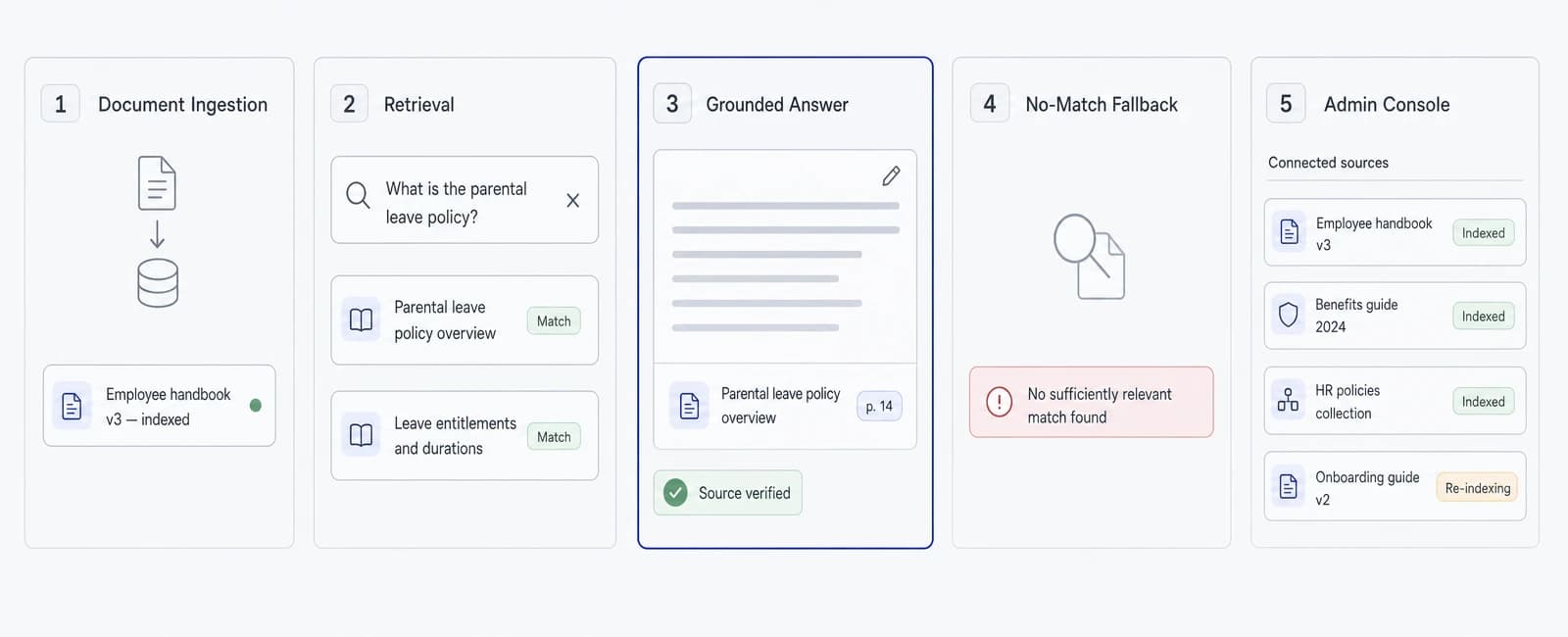
An AI Knowledge Assistant is a representative reference architecture for an internal search system that lets employees ask natural-language questions and receive answers grounded in an organisation's own documents, with citations back to the source. It illustrates a retrieval-and-answer pattern — finding and explaining existing information rather than automating a workflow or taking action on a system's behalf — and is not a description of a system already built for a named client.
The business problem
As an organisation grows, its institutional knowledge tends to spread across a wiki, a file-storage system, a ticketing tool, and a handful of shared drives that nobody fully trusts to be current. Finding an answer to a routine question often means knowing which of those systems to search, guessing at the right keywords, and reading several documents to confirm which one is actually up to date.
That search cost is easy to underestimate because it's paid in small increments — a few minutes here, an interruption to a colleague there — but it recurs constantly, and it scales with headcount and document volume rather than shrinking as an organisation matures. New employees feel it most acutely, but it doesn't go away with tenure; it just shifts to more specialised questions.
An AI Knowledge Assistant, as a category, targets that specific cost: letting someone ask a question in plain language and get an answer grounded in the organisation's own documents, with a citation back to where it came from, instead of a list of search results to read through manually. It is not a system that acts on an organisation's behalf — it answers questions from existing knowledge, and nothing more.
Intended users & roles
- Internal employeeAsks questions about policies, procedures, or product details and expects an answer grounded in current internal documentation, not a guess.
- Support agentLooks up product or policy details mid-conversation with a customer, needing a fast, cited answer rather than a manual search across several tools.
- Subject-matter expert / content curatorReviews flagged answers and gaps, corrects or supplements source documents, and improves what the assistant can retrieve over time.
- IT administratorManages which document sources are connected, how permissions map into the index, and who can access the assistant.
- Compliance or knowledge-management reviewerAudits what sources exist, what's been retrieved, and whether answers stayed within their cited sources.
Core modules
- Document ingestion & indexingConnects to defined document sources, splits content into passages, and indexes it for retrieval — not an open-ended crawl of everything an organisation has ever stored.
- Retrieval-augmented Q&ATurns a natural-language question into a search over the indexed document collection and generates an answer grounded in the passages retrieved, not the model's general knowledge.
- Source citationAttaches a citation and link back to the specific document and passage behind every answer, so it can be verified rather than taken on faith.
- Access-scoped searchApplies the same permission boundaries as the source systems, so a user only ever retrieves passages from documents they could already open directly.
- Feedback & correction loopLets a user flag an answer as unhelpful or incorrect, and a curator review, correct, or improve the underlying source or index entry.
- No-match fallbackRecognises when nothing sufficiently relevant was retrieved and says so, rather than generating an answer with no real basis.
- Conversation & query historyKeeps a record of questions asked and answers given, supporting later review of what the assistant is and isn't answering well.
- Admin consoleManages connected document sources, re-indexing schedules, and which teams or roles have access to the assistant.
Example workflows
- Employee asks a policy questionAn employee would type a question in plain language — "what's our policy on X" — and the system would retrieve the most relevant passages from indexed policy documents and generate an answer citing the specific document and section they came from.
- Support agent looks up a product detail mid-conversationA support agent would query the assistant instead of switching between several internal tools, receiving a cited answer drawn from current product documentation that they could then relay or paste to a customer.
- No relevant source is foundA question that falls outside the indexed document collection would return an explicit "nothing sufficiently relevant found" response rather than a generated answer with no real source behind it.
- Curator resolves a flagged answerA user would flag an answer as unhelpful or wrong, and a subject- matter expert would review the flag, and either correct the source document or add missing content so a future version of the same question retrieves better.
- New document source comes onlineA new wiki space or shared drive would be connected, its permission structure mapped into the index, and its content made retrievable without requiring changes to how existing sources are queried.
Architecture overview
The assistant would be built around a retrieval pipeline consistent with the RAG pattern: incoming documents are chunked, converted into vector embeddings, and stored in a vector index; an incoming question is embedded the same way and matched against that index to retrieve the most relevant passages before any answer is generated.
Generation would call an LLM provider through a defined interface, so the underlying model is an implementation detail rather than a fixed dependency — Anthropic's models are used as the example provider throughout this reference architecture, not the only one the architecture supports.
Retrieval is treated as its own engineered system, not an afterthought: chunking strategy, embedding model choice, and re- ranking of candidate passages are each explicit design decisions, because a capable model paired with weak retrieval still produces answers with no real basis.
The system is designed to run on standard cloud infrastructure (AWS is the example used throughout this reference architecture), with the retrieval index and the generation step as separable components, so the document corpus can grow or be re-indexed without redesigning how answers are generated.
- Document ingestion & indexing
- Retrieval-augmented Q&A
- Source citation
- Access-scoped search
- Feedback & correction loop
- No-match fallback
- Conversation & query history
- Admin console
- Document source ingestion
- Access-permission-aware indexing
- Chunking & re-indexing pipeline
- Query & retrieval logging
- Access-scoped search results
- External provider data handling
- Full audit trail
- Data retention controls
- Encrypted storage & transit
Data & integration flow
- Document source ingestionConnects to defined sources — an internal wiki, file storage, a ticketing system's knowledge base — through their own APIs, rather than an unbounded, undefined crawl.
- Access-permission-aware indexingMaps each source document's existing access permissions into the index at ingestion time, so retrieval can be filtered by what the asking user is allowed to see.
- Chunking & re-indexing pipelineSplits documents into passages sized for retrieval and re-indexes them on a defined schedule or on change, so updates to a source document become retrievable within a known window rather than an unknown one.
- Query & retrieval loggingRecords what was asked, what was retrieved, and what was answered, supporting later review of retrieval quality and gaps in the underlying document collection.
Security, governance & permissions
- Access-scoped search resultsRetrieval is filtered by the same permission boundaries as the source documents, so the assistant never surfaces content a user couldn't already access directly.
- External provider data handlingWhat content is sent to an external AI provider as part of a query, and what isn't, is an explicit, documented decision rather than a default left unexamined.
- Full audit trailEvery question, retrieval, and answer is logged, supporting later review of what was asked and what the assistant surfaced in response.
- Data retention controlsHow long query history and retrieved content are retained is a defined, configurable policy rather than an indefinite default.
- Encrypted storage & transitIndexed content, embeddings, and query data are encrypted at rest and in transit, consistent with standard practice for systems handling internal business data.
AI controls
- Source citation for every answerEvery generated answer includes a citation back to the specific document and passage it was grounded in, so it can be checked rather than trusted outright.
- Defined no-match behaviourWhen retrieval doesn't surface anything sufficiently relevant, the system says so explicitly rather than generating an answer with no supporting source.
- Read-only retrieval, no actionsThe assistant retrieves and explains existing information only — it never writes to, modifies, or triggers an action in another system, unlike a workflow-automation platform.
- Access- and permission-scoped retrievalThe assistant can only retrieve passages from documents the asking user could already access directly, mirroring the source systems' own permission boundaries.
- Human feedback loopFlagged or corrected answers feed back into curator review, improving source content or index quality over time rather than leaving retrieval gaps unaddressed.
- Retrieval quality evaluationA defined set of test questions and the passages they should retrieve is used to measure retrieval quality on an ongoing basis, not judged by spot-checking a handful of answers.
- Prompt & model versioningChanges to prompts, the embedding model, or the underlying language model are tracked and reversible, with retrieval and answer quality evaluated before and after any change.
- Rate & cost controlsAI provider usage is monitored and bounded, since query volume drives cost directly and unbounded usage is its own operational risk.
Relevant services
The engineering disciplines behind AI Knowledge Assistant.
- AI DevelopmentProduction-oriented AI systems, assistants, RAG platforms and intelligent automation for Nordic businesses.
- AI AgentsBounded AI agents built around a fixed tool list, permission tiers, human approval gates, and full decision-trace logging for auditable automation.
- Data Engineering & AnalyticsData pipelines, warehousing, quality validation and BI reporting built to make scattered operational and sensor data reliable enough to trust.
Relevant industries
Where a system like AI Knowledge Assistant creates the most value.
- FinTechCustom fintech software: open banking API integration, KYC workflow automation and data platforms. North Tech Labs is not a licensed payment institution.
- HealthcareCustom scheduling, patient-portal and referral-workflow software for healthcare providers, plus data integration with existing EHR/EMR systems.
- LegalTechCustom legaltech software — contract lifecycle, matter management, and document workflow systems built around confidentiality and existing legal systems.
Relevant technologies
The stack AI Knowledge Assistant is built on.
Related solutions
- AI Operations PlatformA reference architecture for an internal operations platform that combines structured workflows, existing business data, and AI-assisted document processing and drafting — with human review and permission controls built into every consequential step.
- Document Processing PlatformA reference architecture for a document processing system that extracts structured obligations, key dates, clauses, and risk flags from contracts and compliance documents at scale — built around a review and redlining workflow where a person confirms every extraction before it's treated as fact.
Delivery & implementation considerations
- Phased rollout by document sourceTypically implemented one document source or team at a time — starting with a single wiki or knowledge base before connecting additional sources — rather than indexing everything at once.
- Coexistence with existing document systemsDesigned to index and query a client's existing wikis, file storage, and ticketing systems rather than requiring content to be migrated into a new platform.
- Provider flexibilityThe AI-provider integration sits behind a defined interface, so the assistant isn't structurally locked to a single language model provider.
- Evaluation before broad accessRetrieval and answer quality are measured against a defined set of test questions before the assistant is rolled out beyond an initial pilot group.
- Ongoing curation, not a one-time indexSource documents and index coverage are expected to need ongoing review and correction as an organisation's knowledge changes, not a single ingestion that's left to age.
Frequently asked questions
Is this a system you've already built for a client?
No. This page describes a representative reference architecture illustrating our approach to this category of problem — it is not a case study of a completed client project.
How is this different from the AI Operations Platform?
The AI Operations Platform is a workflow-automation reference architecture — it extracts data from incoming documents, drafts responses, and routes AI-suggested actions through human review before they take effect. The AI Knowledge Assistant is a retrieval- and-answer system: it doesn't process documents into downstream systems or suggest actions, it answers natural-language questions by retrieving and citing existing internal documents. One acts on information; the other helps people find it.
Can the assistant see documents a user isn't otherwise allowed to access?
No. Retrieval is designed to respect the same permission boundaries as the underlying document sources, so a user can only retrieve passages from documents they could already access directly.
What happens if the assistant can't find a relevant answer?
It's designed to say so explicitly rather than generate an answer with no supporting source. A defined no-match fallback is part of the architecture, not left to chance.
Does the assistant take actions in other systems?
No. It's restricted to read-only retrieval and answering — it never writes to, modifies, or triggers an action in another system.
Do you have to use Anthropic's models specifically?
No. The architecture integrates a language model provider behind a defined interface. We use Anthropic's models as the example provider throughout this reference architecture, but the assistant isn't structurally dependent on any single provider.
Further reading
- AI Knowledge Assistants for Internal Operations: A Practical GuideA practical guide to internal AI knowledge assistants: how RAG grounds answers in your documents, rollout strategy, governance, and fit criteria.
- OpenAI vs. Anthropic: Choosing a Foundation Model Provider for Your ProjectA practical comparison of OpenAI and Anthropic for applied AI projects — what actually differs, and how to choose based on your workflow.
Ready to discuss your project?
This page describes a representative architecture, not a fixed package. Tell us about your actual requirements and we'll assess what genuinely applies.