This page describes a representative solution and reference architecture. It is not presented as a client case study or as evidence of a completed implementation.
Document Processing Platform
A reference architecture for a document processing system that extracts structured obligations, key dates, clauses, and risk flags from contracts and compliance documents at scale — built around a review and redlining workflow where a person confirms every extraction before it's treated as fact.
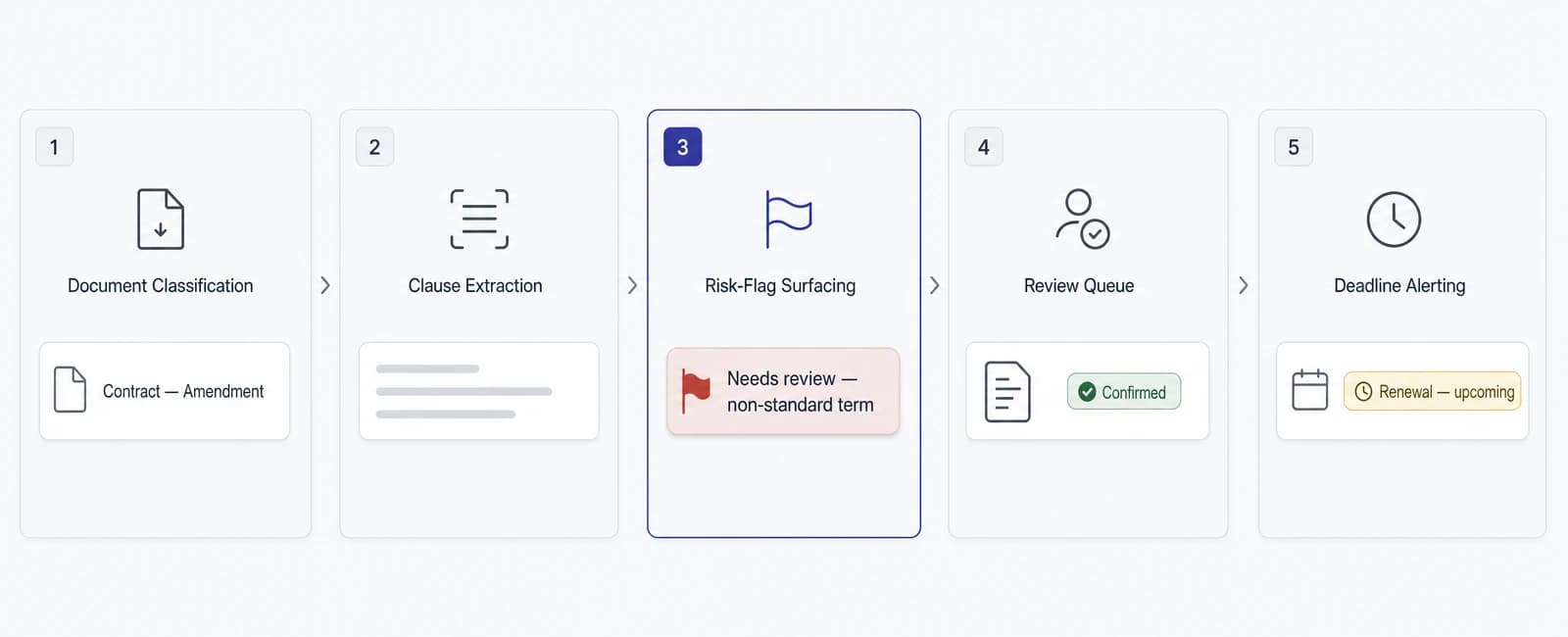
A Document Processing Platform, as described here, is a representative reference architecture for extracting structured obligations, key dates, clauses, and risk flags from contracts and compliance documents at scale, with a review and redlining workflow built around human sign-off. It is narrower in scope than a general operations platform — focused specifically on contract and compliance document review — and it illustrates an approach North Tech Labs would take to this category of problem, not a system already built for a named client.
The business problem
Contracts and compliance documents arrive in volume and in inconsistent formats — signed PDFs, scanned pages, exported word-processor files — each carrying obligations, renewal and termination dates, liability clauses, and non-standard terms buried in unstructured prose. Finding that information today typically means someone opening the document and reading it end to end.
That manual review doesn't scale with volume. A single overlooked renewal date, an unflagged indemnification clause, or a missed non-standard term can carry real financial or legal exposure, and the risk of missing something grows with the number of documents a team is expected to review in a given period, not just the complexity of any one document.
A Document Processing Platform, as a category, addresses this specific problem: extracting structured, page-and-clause-referenced data from contract and compliance documents, surfacing dates and risk indicators that would otherwise require manual reading to find, and routing anything uncertain to a reviewer rather than presenting it as confirmed. It is not a claim that the system reads and understands contracts the way a lawyer or compliance officer would.
The scope here is deliberately narrow — contract and compliance document intake, extraction, and review — rather than a general operational workflow platform. Broader document handling as one capability among several operational workflows is covered separately; this reference architecture is specific to the structured extraction and redlining needs of contract and compliance review.
Intended users & roles
- Legal or compliance reviewerReviews extracted obligations, dates, and risk flags against the source document and confirms, corrects, or rejects each one before it's treated as reliable.
- Contract managerTracks contract status, renewal and termination dates, and outstanding obligations across a portfolio of agreements.
- Compliance analystMonitors compliance documents for flagged clauses and non-standard terms that fall outside an organization's normal risk tolerance.
- Risk or audit leadReviews the audit trail of what was extracted, what a reviewer confirmed or changed, and why, for internal or regulatory review.
- Platform administratorManages roles, document access scopes, and what the extraction layer is permitted to read or flag.
Core modules
- Document classificationSorts incoming documents by type — contract, amendment, compliance filing, policy document — so downstream extraction rules apply the correct schema.
- Clause and obligation extractionIdentifies and extracts individual clauses and the obligations they create, structured against a defined schema rather than left as free text.
- Key-date identification and trackingExtracts renewal, termination, notice, and other procedural dates from document text and tracks them against a calendar of upcoming deadlines.
- Risk-flag surfacingFlags clauses that fall outside expected patterns — unusual liability terms, missing standard clauses, non-standard language — for reviewer attention.
- Redlining and comparison workflowCompares a document against a standard template or a prior version and highlights deviations for a reviewer to assess.
- Review queue with human sign-offPresents every extraction, date, and flag in a structured queue where a reviewer confirms, edits, or rejects it before it's treated as final.
- Obligation and deadline alertingGenerates reminders ahead of tracked dates and outstanding obligations, once those dates have passed human confirmation.
- Portfolio-level reportingAggregates confirmed extractions across a document set to surface portfolio-wide patterns — upcoming renewals, common risk flags, obligation volume.
Example workflows
- Contract intake and extractionA contract would arrive through a defined intake point, be classified by document type, and have its clauses, obligations, and key dates extracted against a schema, with each extraction linked back to the exact page and clause it came from for a reviewer to verify.
- Risk-flag reviewA clause that doesn't match expected patterns — non-standard liability language, an unusual termination trigger, a missing standard clause — would be flagged and routed to a reviewer's queue rather than passed through silently or auto-approved.
- Redline comparison against a templateAn incoming contract would be compared against a standard template or a prior version of the same agreement, with deviations highlighted for a reviewer to assess rather than requiring a manual side-by-side read.
- Deadline confirmation and alertingA renewal or notice date extracted from a document would be presented to a reviewer for confirmation; once confirmed, it would be added to a tracked calendar that generates reminders ahead of the deadline.
- Compliance document monitoringAn incoming compliance filing would be checked against a defined set of required clauses or disclosures, with anything missing or altered surfaced for a compliance analyst's review.
Architecture overview
The platform would be built as a backend processing pipeline with a browser-based review interface — an ingestion and classification layer, a document store with page-level indexing, and a structured database for confirmed obligations, dates, and flags, separate from the unconfirmed extractions awaiting review.
Extraction would combine retrieval over document text with an LLM call constrained to a defined output schema, so each extracted clause, date, or obligation is validated in application code and always resolvable back to its source page and clause rather than presented as free-form output. Anthropic's models are used as the example provider throughout this reference architecture, accessed through a defined interface rather than a hard dependency.
Retrieval-augmented generation is used so extraction and clause comparison are grounded in the specific document text being reviewed, rather than relying on a model's general knowledge of contract language — reducing the chance of a plausible-sounding but incorrect extraction going unchecked.
The system is designed to run on standard cloud infrastructure, with a clear boundary between the document store holding potentially confidential contract and compliance content and any component that calls an external AI provider, so what data leaves that boundary is a deliberate, documented decision rather than a default.
- Document classification
- Clause and obligation extraction
- Key-date identification and tracking
- Risk-flag surfacing
- Redlining and comparison workflow
- Review queue with human sign-off
- Obligation and deadline alerting
- Portfolio-level reporting
- Document intake
- Contract and document management system integration
- OCR and format normalization
- Validation before write
- Calendar and reminder integration
- Confidentiality-scoped access
- Full audit trail
- Data retention and handling
- Encrypted storage and transit
- Role-based permissions
Data & integration flow
- Document intakeContracts and compliance documents enter through a defined intake point — upload, a shared document store, or an integration endpoint — rather than an open-ended set of sources.
- Contract and document management system integrationReads from and writes confirmed data back to existing contract lifecycle or document management systems through defined API integrations, rather than replacing them.
- OCR and format normalizationScanned or image-based documents are processed through OCR before extraction, so the same schema-based pipeline applies regardless of source format.
- Validation before writeExtracted clauses, dates, and flags are validated against expected schemas and confirmed by a reviewer before being written to any downstream system or calendar.
- Calendar and reminder integrationConfirmed key dates are pushed to a tracked calendar or existing scheduling system so deadline reminders don't depend on a separate manual process.
Security, governance & permissions
- Confidentiality-scoped accessAccess to documents and extracted data is scoped by matter, client, or document set, reflecting the confidentiality that contract and compliance content typically carries.
- Full audit trailEvery extraction, reviewer confirmation, edit, and rejection is logged with who acted and when, supporting later internal or regulatory review.
- Data retention and handlingWhat documents and extracted data are stored, for how long, and what's sent to an external AI provider are explicit, documented decisions rather than defaults left unexamined.
- Encrypted storage and transitDocuments and extracted data are encrypted at rest and in transit, consistent with standard practice for systems handling confidential contract and compliance content.
- Role-based permissionsWhat a given user or role can view, extract, confirm, or export is scoped explicitly, consistent with least-privilege access rather than broad default access.
AI controls
- Human review before any extraction is trustedNo extracted obligation, date, clause, or risk flag is written to a downstream system or treated as fact until a reviewer has confirmed it.
- Confidence thresholdsExtractions below a defined confidence threshold are routed to a reviewer by default rather than presented as reliable.
- Source citation to clause and pageEvery extraction links back to the specific clause and page in the source document it was drawn from, so a reviewer can verify it against the original text rather than trusting the output alone.
- Structured, schema-validated outputsExtraction output is constrained to a defined schema and validated in application code before it reaches a reviewer's queue or any downstream system.
- Retrieval grounded in the source documentExtraction and comparison are grounded in retrieval over the specific document being processed, reducing reliance on a model's general knowledge of contract language.
- Defined fallback behaviourWhen extraction fails, times out, or produces output that doesn't validate against the schema, the item is routed to manual review rather than silently dropped or guessed.
- Evaluation datasetsA defined set of test documents and expected extractions is used to measure extraction quality on an ongoing basis, not judged by spot-checking alone.
- Prompt and model versioningChanges to extraction prompts or the underlying model are tracked and reversible, with extraction accuracy evaluated before and after any change.
Relevant services
The engineering disciplines behind Document Processing Platform.
Relevant industries
Where a system like Document Processing Platform creates the most value.
- LegalTechCustom legaltech software — contract lifecycle, matter management, and document workflow systems built around confidentiality and existing legal systems.
- InsuranceCustom software for policy administration, claims workflows, and data integration in insurance operations — not actuarial or underwriting services.
- FinTechCustom fintech software: open banking API integration, KYC workflow automation and data platforms. North Tech Labs is not a licensed payment institution.
Relevant technologies
The stack Document Processing Platform is built on.
Related solutions
- AI Operations PlatformA reference architecture for an internal operations platform that combines structured workflows, existing business data, and AI-assisted document processing and drafting — with human review and permission controls built into every consequential step.
- AI Knowledge AssistantA reference architecture for an internal knowledge assistant that answers employee questions in natural language, grounded in an organisation's own documents and wikis — every answer traceable to the source it came from, and scoped to what the asking user is already permitted to see.
- Healthcare Workflow PlatformA reference architecture for an administrative healthcare workflow platform that combines appointment scheduling, a patient self-service portal, and referral coordination with an integration layer connecting to existing EHR/EMR systems — scoped entirely to administrative and operational functionality.
Delivery & implementation considerations
- Phased rollout by document typeTypically implemented starting with a single document type or clause category before expanding to a broader document set, rather than a single big-bang rollout across all contract types.
- Coexistence with existing contract and document systemsDesigned to integrate with a client's existing contract lifecycle or document management system rather than requiring migration away from it.
- Provider flexibilityThe AI-provider integration is architected behind a defined interface, so the platform isn't structurally locked to a single provider.
- Evaluation before expanding scopeThe range of clause types or document categories processed with reduced review, if any, is expanded only after evaluation data supports it — not assumed from the outset.
- Reviewer workload sizingQueue volume and reviewer capacity are sized together during rollout, since the platform is designed to reduce manual reading time, not remove the review step itself.
Frequently asked questions
Is this a system you've already built for a client?
No. This page describes a representative reference architecture illustrating our approach to this category of problem — it is not a case study of a completed client project.
How is this different from the AI Operations Platform?
The AI Operations Platform is a broader reference architecture where general document intake and extraction is one capability among several operational workflows. This Document Processing Platform is narrower and specific to contracts and compliance documents — extracting structured obligations, key dates, clauses, and risk flags, with a document-review and redlining workflow built around that specific need.
Does this replace legal or compliance review?
No. It's designed to reduce the manual reading effort involved in finding obligations, dates, and risk indicators in documents — every extraction still requires human confirmation before it's treated as reliable, and it does not constitute legal advice.
Is extracted data always accurate?
No. Extraction can be wrong or incomplete, which is why confidence thresholds, source citation to the original clause and page, and mandatory human review are built into the architecture rather than treated as optional.
Do you have to use Anthropic's models specifically?
No. The architecture integrates an AI provider behind a defined interface. We use Anthropic's models as the example provider in this reference architecture, but the platform isn't structurally dependent on any single provider.
Can this integrate with our existing contract management system?
Integrating with an existing contract lifecycle or document management system is a core part of this reference architecture rather than requiring a migration away from it — confirmed extractions are written back through defined API integrations.
Ready to discuss your project?
This page describes a representative architecture, not a fixed package. Tell us about your actual requirements and we'll assess what genuinely applies.