This page describes a representative solution and reference architecture. It is not presented as a client case study or as evidence of a completed implementation.
AI Operations Platform
A reference architecture for an internal operations platform that combines structured workflows, existing business data, and AI-assisted document processing and drafting — with human review and permission controls built into every consequential step.
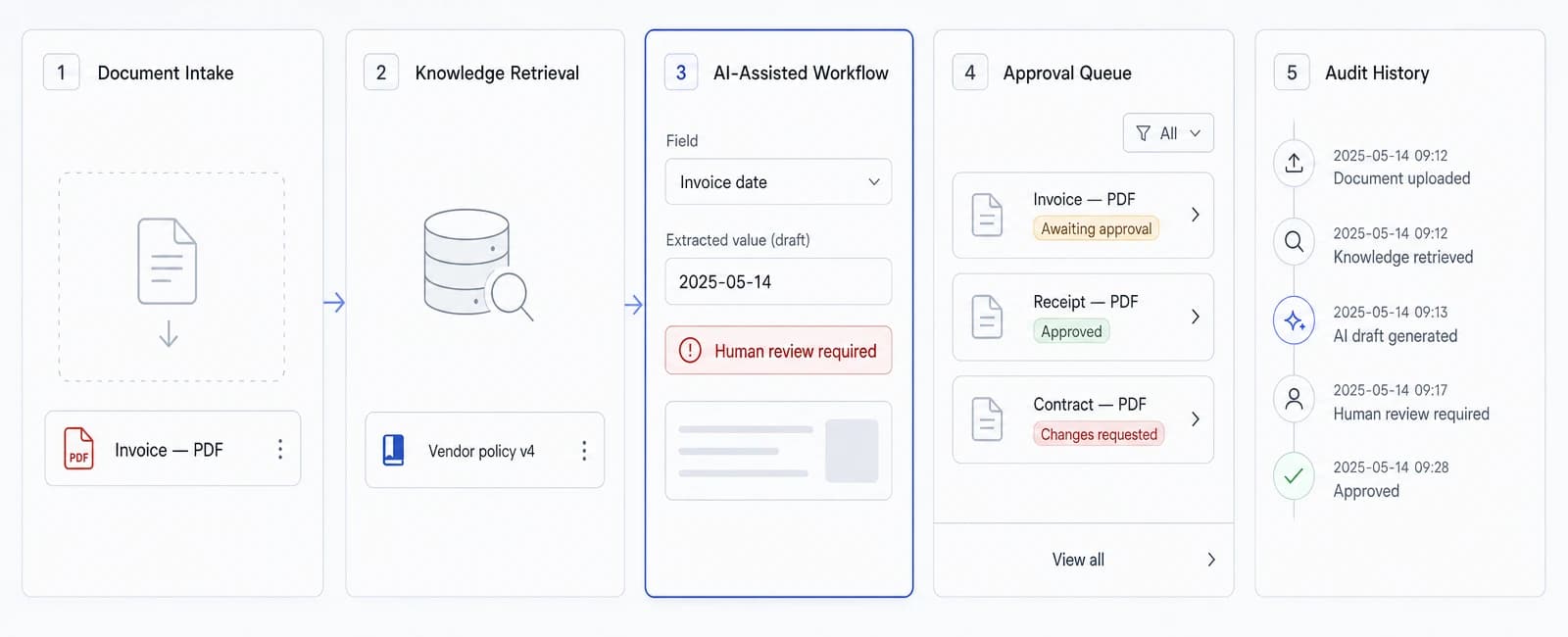
An AI Operations Platform is a representative reference architecture for an internal operational system that combines structured workflows, existing business data, document processing, and AI-assisted actions under explicit human review and permission controls. It illustrates how North Tech Labs would approach a common operational need — reducing manual document and data handling while keeping consequential decisions with a person — not a description of a system we have already built for a named client.
The business problem
Many operational teams run a mix of structured systems (an ERP, a ticketing tool, spreadsheets) and a steady stream of unstructured input — incoming documents, reports, emails, requests — that has to be read, triaged, and acted on. The structured systems are usually fine on their own; the bottleneck is the manual effort of getting unstructured input into a state those systems can use.
That manual effort scales roughly linearly with volume, which becomes a real constraint as an operation grows: more documents, more requests, more exceptions to review, without a proportional increase in staff available to process them.
An AI Operations Platform, as a category, is a way to reduce that specific bottleneck — extracting structured data from documents, drafting a first-pass response or summary, and surfacing exceptions for review — while keeping a person responsible for anything with real consequence. It is not a general claim that AI can run an operation unattended.
Intended users & roles
- Operations coordinatorTriages incoming documents and requests, reviews AI-suggested actions, and handles exceptions the system flags.
- Team supervisorOversees a queue of pending reviews, reassigns work, and approves higher-impact actions before they take effect.
- Compliance or audit reviewerReviews the audit trail of what the system did, what a person approved, and why, for internal or regulatory review.
- Platform administratorManages roles, permissions, and what data or actions the AI-assisted layer can access.
Core modules
- Document intake & processingIngests incoming documents and extracts structured fields for downstream systems to use.
- Structured data extractionConverts unstructured text into a defined schema — validated before it reaches any other system.
- AI-assisted drafting & summarisationPrepares a first-pass draft response, report, or summary for a person to review and finalize.
- Review & approval queueA structured queue where AI-suggested actions wait for human review before anything consequential takes effect.
- Role-based access controlScopes what each user, and what the AI-assisted layer itself, can view or act on based on role.
- Audit & activity logRecords what was extracted, suggested, approved, or rejected, and by whom, for later review.
- Operational dashboardsSurfaces queue status, exception volume, and processing activity for supervisors to monitor.
Example workflows
- Incoming document triageA document would arrive, structured fields would be extracted and validated, and the record would be routed to the relevant queue, with low-confidence extractions flagged for manual review rather than assumed correct.
- Drafted response with sign-offThe system would prepare a draft response or report based on available data and cite the sources it used, with a team member reviewing, editing if needed, and approving before it's sent or finalised.
- Exception escalationAn item that doesn't fit the expected pattern — ambiguous data, a low-confidence extraction, a request outside normal parameters — would be routed to a supervisor instead of being auto-processed.
- Scheduled activity summaryA periodic summary of queue activity, exceptions, and pending approvals would be generated for a supervisor's review, consolidating information that would otherwise require manually checking several systems.
Architecture overview
The platform would be built as a web-based backend service with a browser interface for operators and supervisors — a Node.js API layer, persistent storage for structured records and audit history, and a task/queue layer coordinating work between automated processing steps and human review points.
AI-assisted steps (extraction, drafting, summarisation) would call an LLM provider through a defined interface, so the underlying model provider is an implementation detail rather than a hard architectural dependency — OpenAI is used as the example provider throughout this reference architecture, not the only one it supports.
The system is designed to run on standard cloud infrastructure (AWS is the example used throughout this reference architecture), with clear boundaries between the parts of the system that call an external AI provider and the parts that don't, so data-handling decisions can be made deliberately per data type rather than uniformly.
- Document intake & processing
- Structured data extraction
- AI-assisted drafting & summarisation
- Review & approval queue
- Role-based access control
- Audit & activity log
- Operational dashboards
- Document ingestion
- Existing system integration
- Validation before write
- Event-driven task creation
- Role-based permissions
- Full audit trail
- Data retention & handling
- Encrypted storage & transit
Data & integration flow
- Document ingestionIncoming documents enter through a defined intake point (upload, email, or integration endpoint) rather than an open-ended set of sources.
- Existing system integrationStructured data is written to and read from existing internal systems (ERP, ticketing, databases) through defined API integrations, not by replacing those systems.
- Validation before writeExtracted or AI-suggested data is validated against expected schemas and business rules before it's written anywhere downstream.
- Event-driven task creationIncoming items and system events generate queue tasks, so work is tracked explicitly rather than relying on someone remembering to check.
Security, governance & permissions
- Role-based permissionsAccess to data, queues, and approval actions is scoped by role, consistent with least-privilege access rather than broad default access.
- Full audit trailEvery extraction, AI suggestion, approval, and rejection is logged with who acted and when, supporting later review.
- Data retention & handlingWhat data is stored, for how long, and what's sent to an external AI provider are explicit, documented decisions — not defaults left unexamined.
- Encrypted storage & transitData at rest and in transit is encrypted, consistent with standard practice for systems handling internal business data.
AI controls
- Human review for consequential actionsAny action with real business, financial, or customer-facing consequence requires explicit human approval before it takes effect.
- Role- and permission-scoped accessThe AI-assisted layer can only read and act on data within the same role-based boundaries as a human user in an equivalent role.
- Source citationWhere the system drafts a response or summary from internal data, it cites the specific records or documents used, rather than presenting output without provenance.
- Confidence thresholds & validationExtractions and suggestions below a defined confidence threshold are routed to manual review rather than auto-accepted.
- Structured, schema-validated outputsAI-generated outputs are constrained to defined schemas and validated in application code before being trusted by any downstream process.
- Deterministic checks stay deterministicBusiness rules and calculations with a single correct answer are implemented as regular code, never delegated to a model's judgment.
- Prompt & model versioningChanges to prompts or the underlying model are tracked and reversible, with behaviour evaluated before and after any change.
- Evaluation datasetsA defined set of test cases is used to measure extraction and drafting quality on an ongoing basis, not judged by spot-checking alone.
- Rate & cost controlsAI provider usage is monitored and bounded, since costs scale with volume and unbounded usage is an operational risk in its own right.
- Defined fallback behaviourWhen a model call fails, times out, or produces invalid output, the system falls back to a defined behaviour — typically routing to manual review — rather than failing silently or guessing.
- Restricted tool accessWhere the AI-assisted layer can trigger actions in other systems, that access is limited to an explicit, minimal set of actions, not open-ended system access.
Relevant services
The engineering disciplines behind AI Operations Platform.
Relevant industries
Where a system like AI Operations Platform creates the most value.
- ManufacturingCustom manufacturing software, operational platforms and connected systems for companies modernising production across Sweden and the Nordic region.
- Logistics and MobilityCustom logistics, fleet, mobility and transport software for companies managing complex operations across the Nordic region.
- Climate Tech and EnergySoftware platforms, data systems and digital products for energy, electrification and climate-focused businesses across the Nordic region.
Related solutions
- AI Knowledge AssistantA reference architecture for an internal knowledge assistant that answers employee questions in natural language, grounded in an organisation's own documents and wikis — every answer traceable to the source it came from, and scoped to what the asking user is already permitted to see.
- Document Processing PlatformA reference architecture for a document processing system that extracts structured obligations, key dates, clauses, and risk flags from contracts and compliance documents at scale — built around a review and redlining workflow where a person confirms every extraction before it's treated as fact.
Delivery & implementation considerations
- Phased rollout by workflowTypically implemented one workflow at a time — starting with document intake and extraction before layering in drafting or automation — rather than a single big-bang rollout.
- Coexistence with existing systemsDesigned to integrate with a client's existing ERP, ticketing, or data systems rather than requiring their replacement.
- Provider flexibilityThe AI-provider integration is architected behind a defined interface, so the platform isn't structurally locked to a single provider.
- Evaluation before scaling automationThe share of work that runs with reduced human review, if any, is expanded only after evaluation data supports it — not assumed from the outset.
Frequently asked questions
Is this a system you've already built for a client?
No. This page describes a representative reference architecture illustrating our approach to this category of problem — it is not a case study of a completed client project.
Does this platform operate fully autonomously?
No. The architecture requires human review and approval for any consequential action. AI-assisted steps handle extraction, drafting, and suggestion — not unsupervised decision-making.
Does this replace operations staff?
No. It's designed to reduce manual document and data-handling effort so staff can focus on review, judgment, and exceptions — not to replace the people doing that work.
Is data extraction always accurate?
No. Extraction and drafting can be wrong, which is why confidence thresholds, validation, and human review for consequential items are built into the architecture rather than treated as optional.
Do you have to use OpenAI specifically?
No. The architecture integrates an AI provider behind a defined interface. We typically start with OpenAI's models, but the platform isn't structurally dependent on any single provider.
Will this guarantee cost savings?
No. Potential efficiency gains depend on the specific workflow, document volume, and how much manual review remains necessary. We don't provide a guaranteed savings figure without evaluating the actual use case.
Further reading
- AI Agents vs. Chatbots: What's the Real DifferenceChatbots, LLM chat assistants, and AI agents explained with a clear technical line, a comparison table, and a decision framework for your use case.
- OpenAI vs. Anthropic: Choosing a Foundation Model Provider for Your ProjectA practical comparison of OpenAI and Anthropic for applied AI projects — what actually differs, and how to choose based on your workflow.
Ready to discuss your project?
This page describes a representative architecture, not a fixed package. Tell us about your actual requirements and we'll assess what genuinely applies.