This page describes a representative solution and reference architecture. It is not presented as a client case study or as evidence of a completed implementation.
Energy Asset Management Platform
A reference architecture for a software platform that consolidates energy asset data — from meters, EV chargers, and sensors already installed across multiple vendors and sites — into one monitoring, alerting, and reporting view for operations and sustainability teams.
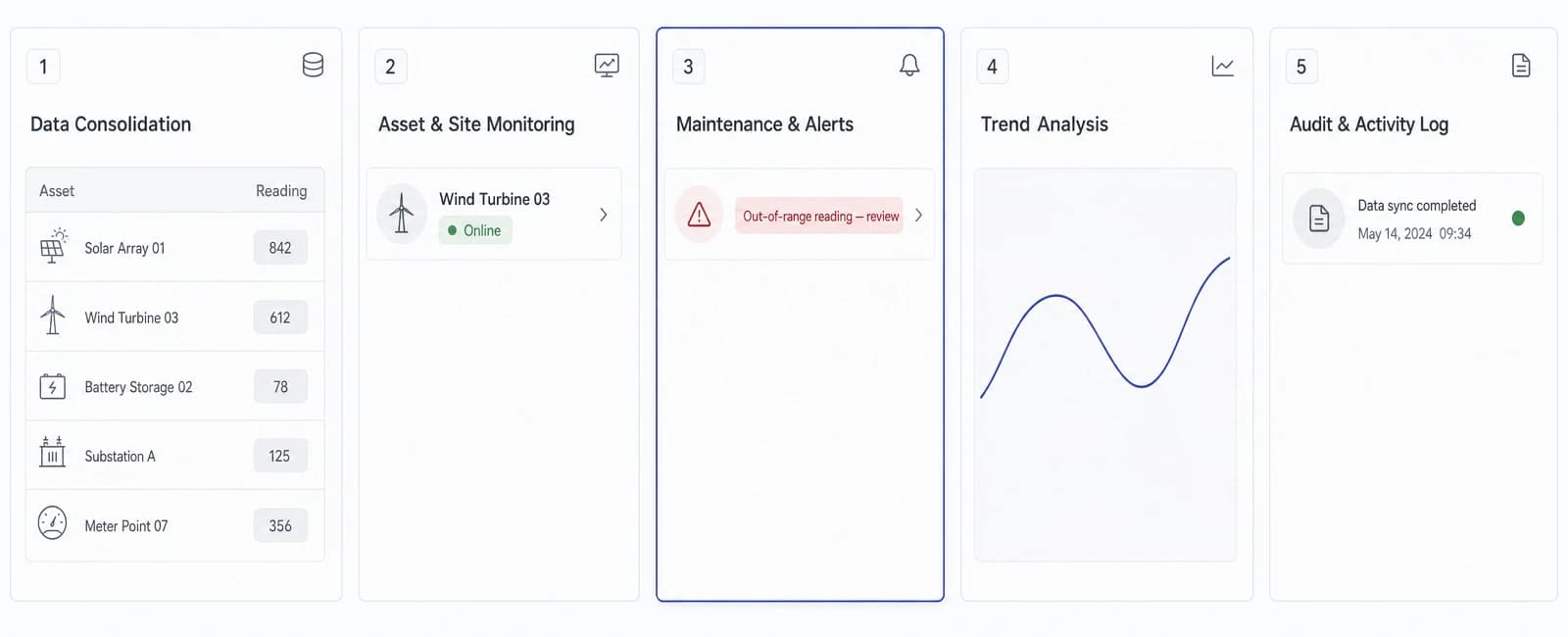
An Energy Asset Management Platform is a representative reference architecture for a software layer that consolidates energy asset data — from meters, EV chargers, and sensors supplied by multiple vendors — into a single monitoring, alerting, and reporting view for operations and sustainability teams. It illustrates how North Tech Labs would approach this category of problem using data from hardware a client already has installed — not a description of a system already built for a named client, and not a claim of building the metering or sensor hardware itself.
The business problem
Organisations managing distributed energy assets — meters, EV chargers, on-site sensors, sub-metering equipment — typically end up with that data spread across several vendor portals, gateway devices, and export formats, none of which were designed to talk to each other. Getting a single, current view of asset status or consumption usually means someone manually pulling exports from multiple systems and reconciling them by hand.
That fragmentation compounds over time as more sites, meters, or charging points are added, each potentially from a different vendor with its own data format and update frequency. Monitoring becomes reactive — an issue is noticed when someone happens to check a specific portal, or when a report is due, rather than surfaced as it happens.
Reporting is a related but separate problem: sustainability, cost, or compliance-support reporting depends on figures that can be traced back to their underlying readings, which a set of disconnected spreadsheets and vendor exports generally cannot provide in a structured, repeatable way.
An Energy Asset Management Platform, as a category, addresses this by consolidating data from existing metering, sensor, and EV-charging hardware into a single system that operations and sustainability teams can monitor and report from. It is not a claim that software alone improves energy performance, and it does not involve North Tech Labs designing, manufacturing, or installing any metering or sensor hardware.
Intended users & roles
- Energy operations managerMonitors consolidated asset status and consumption data across sites, and coordinates response to alerts or exceptions.
- Sustainability or reporting analystCompiles periodic sustainability, cost, or compliance-support reports and needs figures traceable back to underlying readings.
- Field technicianInvestigates and resolves flagged issues on-site, and records maintenance or service activity against the relevant asset.
- Asset or facilities ownerReviews asset-level and portfolio-level performance summaries to inform decisions about upkeep, upgrades, or vendor changes.
- Platform administratorManages data-source connections, user roles, and which vendors or sites feed into the consolidated platform.
Core modules
- Multi-source energy data consolidationIngests readings and status data from meters, EV chargers, and sensors across multiple vendors into a single, consistent data model.
- Asset & site monitoring dashboardsGives operations teams a current view of asset status, consumption, and site-level activity without checking separate vendor portals.
- Maintenance & alert workflowsFlags assets that go offline, report out-of-range readings, or miss expected check-ins, and routes them to a technician for review.
- Reporting & compliance-support data exportCompiles consumption, status, and maintenance history into structured reports, with figures traceable back to their source readings.
- Historical trend & utilisation analysisRetains historical readings to support trend review and utilisation comparisons across sites or asset types over time.
- Role-based access controlScopes what each user — operator, analyst, technician, administrator — can view or act on within the platform.
- Audit & activity logRecords data ingestion, alerts, acknowledgements, and reporting exports, along with who acted and when, for later review.
Example workflows
- Consolidated reading ingestionMeter, sensor, and EV-charger readings from several vendor systems would be ingested on their respective schedules, normalised into a common format, and validated against expected ranges before being written to the consolidated data store.
- Offline or out-of-range asset alertIf a meter or sensor stopped reporting, or a reading fell outside an expected range, the platform would flag the asset and notify an operations manager or technician rather than the gap going unnoticed until the next manual check.
- Maintenance follow-upA technician dispatched to investigate a flagged asset would record the outcome and any service performed, closing the loop between the alert and the resolution in the same system used to monitor the asset.
- Periodic compliance-support reportA sustainability or reporting analyst would generate a report drawing on consolidated readings for a defined period, with each reported figure traceable back to its underlying source data rather than re-entered by hand.
- Multi-site utilisation reviewAn asset owner would review a portfolio-level summary comparing consumption or utilisation across sites, compiled from ingested data rather than assembled manually from separate vendor exports.
Architecture overview
North Tech Labs would build the software layer in this reference architecture — the ingestion pipeline, consolidated data store, monitoring dashboards, and reporting workflows — not the metering, sensor, or EV-charging hardware itself. The platform is designed to ingest data from meters, sensors, and chargers a client already has installed, through each vendor's existing data feed or export mechanism; it does not involve designing, manufacturing, or installing physical metering or sensor equipment.
The backend would be a Node.js API layer with PostgreSQL as the system of record for normalised readings, asset metadata, and maintenance history, alongside a scheduled and event-driven ingestion layer that reconciles data arriving on different schedules and in different formats from each connected vendor.
Because source systems vary in reliability and reporting frequency, the ingestion layer is designed to tolerate missing or delayed data from any one source without blocking ingestion from the others, and to surface a data gap explicitly rather than silently interpolating a value in its place.
The system is designed to run on standard cloud infrastructure (AWS is the example used throughout this reference architecture), with a clear boundary between the integration layer that talks to third-party vendor systems and the core platform, so a new meter or charging vendor can be added without changing how the rest of the platform works.
- Multi-source energy data consolidation
- Asset & site monitoring dashboards
- Maintenance & alert workflows
- Reporting & compliance-support data export
- Historical trend & utilisation analysis
- Role-based access control
- Audit & activity log
- Multi-vendor meter & sensor ingestion
- EV-charger data integration
- Existing system integration
- Validation before write
- Event-driven alerting
- Role-based permissions
- Traceable data lineage
- Full audit trail
- Encrypted storage & transit
- Data retention decisions
Data & integration flow
- Multi-vendor meter & sensor ingestionReadings are ingested from each vendor's existing API, gateway, or export mechanism through a defined integration, not by North Tech Labs supplying or installing that hardware.
- EV-charger data integrationCharging session and status data is ingested from existing EV-charging network platforms, rather than the reference architecture including charging hardware itself.
- Existing system integrationConsolidated data is made available to existing reporting, ERP, or sustainability-tracking systems through defined API integrations, rather than requiring their replacement.
- Validation before writeIncoming readings are validated against expected ranges and formats before being written to the consolidated data store.
- Event-driven alertingOffline assets, out-of-range readings, and missed check-ins generate alerts automatically, rather than depending on someone noticing them in a vendor portal.
Security, governance & permissions
- Role-based permissionsAccess to asset data, alerts, and reporting exports is scoped by role, consistent with least-privilege access rather than broad default access.
- Traceable data lineageReported figures are traceable back to the underlying readings and their source, supporting compliance-support reporting without claiming a certified compliance or ESG outcome.
- Full audit trailData ingestion, alerts, acknowledgements, and report exports are logged with who or what acted and when, supporting later review.
- Encrypted storage & transitAsset and consumption data are encrypted at rest and in transit, consistent with standard practice for systems handling operational data.
- Data retention decisionsHow long historical readings and activity logs are retained is an explicit, documented decision rather than an unexamined default.
Relevant services
The engineering disciplines behind Energy Asset Management Platform.
- Data Engineering & AnalyticsData pipelines, warehousing, quality validation and BI reporting built to make scattered operational and sensor data reliable enough to trust.
- IoT & Connected Systems SoftwareSoftware for ingesting, processing, and acting on data from connected equipment and field devices, integrated with your existing operational systems.
- Custom Software DevelopmentDesign and development of secure, scalable custom software for companies across Sweden and the Nordic region.
Relevant industries
Where a system like Energy Asset Management Platform creates the most value.
Related solutions
- Fleet Management PlatformA reference architecture for a fleet management platform that turns existing telematics and GPS data into real-time vehicle visibility, coordinated dispatch, and proactive maintenance scheduling — as a software layer on top of hardware a fleet already has.
- Manufacturing Execution System (MES)A reference architecture for a Manufacturing Execution System that tracks work orders, machine activity, and quality checkpoints on the shop floor in real time — coordinating execution, not business planning or finance, and designed to work alongside a plant's existing ERP.
Delivery & implementation considerations
- Phased rollout by site or asset segmentTypically piloted on a handful of sites or a single asset type before a wider rollout, so integration and data-quality assumptions can be checked early.
- Coexistence with existing metering and sensor vendorsDesigned to integrate with a client's existing meters, sensors, and EV chargers rather than requiring hardware replacement, since North Tech Labs builds the software layer, not the devices.
- Data quality dependencyMonitoring and reporting accuracy depend on the reliability of the underlying vendor data feeds — data gaps are surfaced explicitly rather than smoothed over silently.
- Vendor and format variabilityEach connected meter, sensor, or charging vendor may need its own integration work against that vendor's specific data feed, format, and update frequency.
Frequently asked questions
Is this a system you've already built for a client?
No. This page describes a representative reference architecture illustrating our approach to this category of problem — it is not a case study of a completed client project.
Do you build the energy hardware, meters, or sensors?
No. North Tech Labs builds the software layer — the platform that ingests and acts on data from meters, sensors, and EV chargers a client already has installed. We don't design, manufacture, or install metering or sensor hardware.
Can this guarantee emissions reductions or energy savings?
No. The platform can support monitoring, alerting, and compliance-support reporting — it cannot by itself guarantee an emissions reduction, energy saving, or other environmental outcome, and we don't claim otherwise.
Can the platform work with any meter or EV-charging vendor?
Integration depends on the specific vendor's data feed or export mechanism. The architecture is designed around a defined ingestion interface rather than a single vendor, but any given integration still needs to be built against that vendor's actual data.
Does this replace an operations or sustainability team?
No. It's designed to consolidate data that would otherwise be spread across multiple vendor portals, so a team spends less time reconciling data and more time on monitoring and decision-making — not to replace their judgment.
Is data from every connected source always accurate?
No. Readings can be missing, delayed, or incorrect at the source, which is why validation and explicit data-gap handling are part of the architecture rather than an assumption that every feed is always reliable.
Ready to discuss your project?
This page describes a representative architecture, not a fixed package. Tell us about your actual requirements and we'll assess what genuinely applies.