This page describes a representative solution and reference architecture. It is not presented as a client case study or as evidence of a completed implementation.
Fleet Management Platform
A reference architecture for a fleet management platform that turns existing telematics and GPS data into real-time vehicle visibility, coordinated dispatch, and proactive maintenance scheduling — as a software layer on top of hardware a fleet already has.
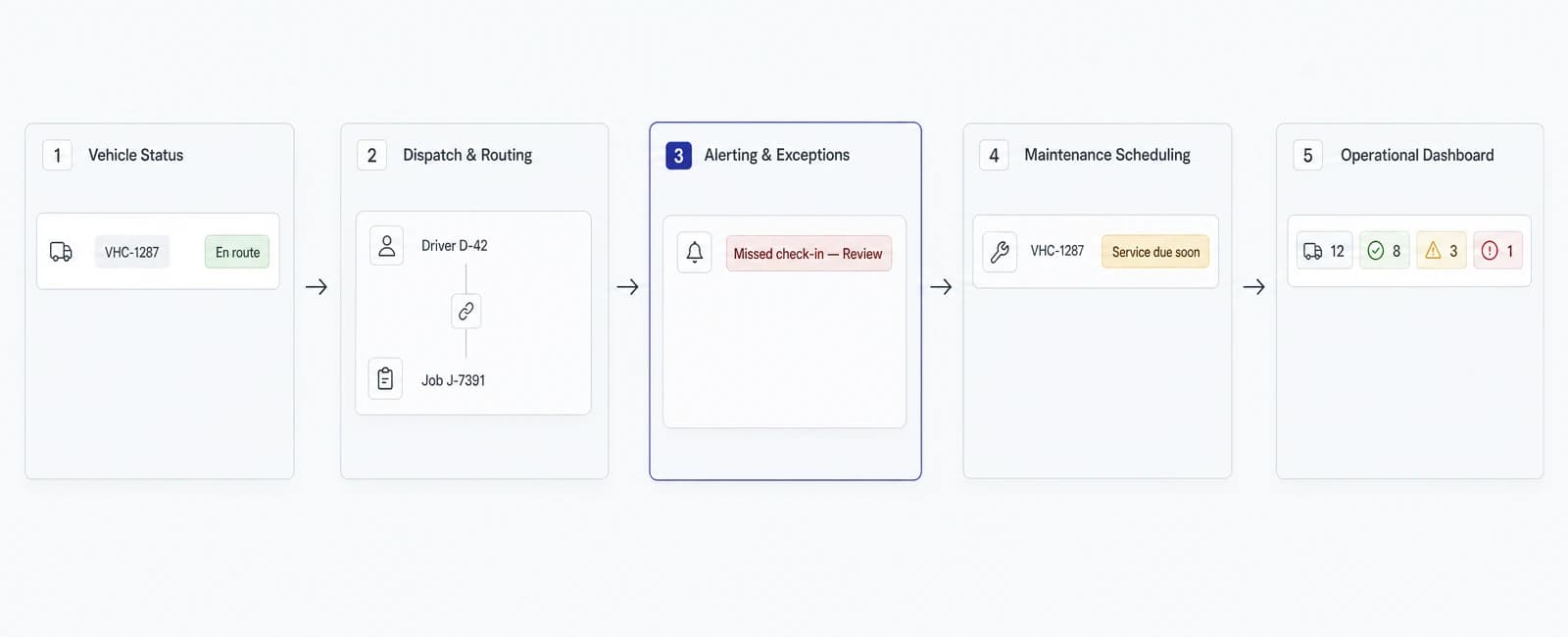
A Fleet Management Platform is a representative reference architecture for a software layer that gives dispatchers, fleet managers, and drivers a shared, real-time view of vehicle status, location, and maintenance needs, and coordinates dispatch and reporting around that data. It illustrates how North Tech Labs would approach this category of problem using data from existing telematics and GPS hardware — not a description of a system already built for a named client, and not a claim of building the vehicle hardware itself.
The business problem
Fleets running without a shared operational system tend to rely on drivers calling in status updates and dispatchers keeping track of vehicle assignments in spreadsheets or on a whiteboard. That works at small scale, but it breaks down as the number of vehicles, drivers, and daily jobs grows, because none of that information is visible to anyone who isn't on the phone at the right moment.
Without real-time visibility into where vehicles are and what state they're in, dispatch decisions get made on incomplete information — the nearest available vehicle isn't obvious, and a vehicle already close to a maintenance threshold can get assigned another long route anyway. Maintenance itself is often reactive: a vehicle gets serviced after something fails, rather than on a schedule informed by actual usage and condition data.
A Fleet Management Platform, as a category, addresses this by consolidating vehicle location, status, and usage data — sourced from telematics and GPS hardware a fleet already has installed — into one system that dispatchers, fleet managers, and maintenance coordinators can all work from. It is not a claim that the software replaces the judgment of the people running day-to-day operations, and it does not involve North Tech Labs building or supplying any in-vehicle hardware.
Intended users & roles
- DispatcherAssigns jobs and routes to available vehicles and drivers based on real-time location and status, and handles re-assignment when plans change.
- Fleet managerMonitors overall fleet status, utilisation, and maintenance needs, and reviews reporting on vehicle and driver activity.
- DriverReceives job assignments through a mobile app, reports status from the road, and flags vehicle issues as they arise.
- Maintenance coordinatorTracks maintenance schedules and alerts derived from vehicle usage data, and schedules service before a minor issue becomes a breakdown.
- Platform administratorManages user roles, vehicle records, and what data feeds and integrations the platform is connected to.
Core modules
- Real-time vehicle trackingDisplays current vehicle location and status on a live map, built from data ingested from existing telematics and GPS hardware rather than any hardware North Tech Labs would supply.
- Dispatch & route coordinationLets a dispatcher assign jobs to available vehicles and drivers, re-assign when conditions change, and see assignment status at a glance.
- Driver mobile appGives drivers their assigned jobs, turn-by-turn handoff to a routing provider, and a way to report status, delays, or vehicle issues.
- Maintenance schedulingTracks service intervals and usage-based maintenance triggers (mileage, engine hours) and surfaces upcoming or overdue service needs.
- Fuel & utilisation reportingAggregates fuel consumption and vehicle utilisation data ingested from existing systems into reports for fleet managers.
- Alerting & exception handlingFlags events that fall outside expected parameters — a vehicle stopped mid-route, a missed check-in, an overdue service — for a dispatcher or manager to review.
- Role-based access controlScopes what each user — dispatcher, driver, maintenance coordinator, administrator — can view or act on within the platform.
- Operational dashboardsGives fleet managers a consolidated view of vehicle status, active jobs, and open exceptions across the fleet.
Example workflows
- Real-time job assignmentA new job would come in, and the dispatcher would see which vehicles are currently available and nearby based on live location data, then assign the job with the assignment reflected immediately in the driver's mobile app.
- Vehicle status exceptionIf a vehicle's telematics feed showed it stopped for longer than expected on an active route, the system would flag the event to the dispatcher rather than assuming it was a normal stop, so a person decides whether to intervene.
- Maintenance threshold alertAs a vehicle's mileage or engine hours approached a defined service interval, the maintenance coordinator would receive an alert ahead of time, allowing service to be scheduled before the vehicle reached the threshold rather than after a fault occurred.
- Driver-reported issueA driver noticing a mechanical issue would report it through the mobile app, creating a record visible to the maintenance coordinator and dispatcher, rather than the issue being reported informally or not at all.
- Utilisation reviewA fleet manager would review a periodic report on vehicle utilisation and fuel consumption, compiled from ingested telematics and fuel-system data, to inform decisions about fleet sizing or route assignment — not to auto-generate those decisions.
Architecture overview
North Tech Labs would build the software layer in this reference architecture — the backend services, dispatch and mapping interface, and driver mobile app — not the vehicle hardware. The platform is designed to ingest data from existing telematics devices and GPS hardware a fleet already has installed, in the same way described for logistics and mobility software generally; it does not involve designing, manufacturing, or installing in-vehicle tracking devices.
The backend would be a Node.js API layer with persistent storage for vehicle records, job assignments, and maintenance history, alongside an event pipeline that ingests location and status updates from telematics feeds in near-real time rather than on a periodic batch schedule.
The driver-facing application would be a React Native mobile app, built to tolerate intermittent connectivity in the field — queuing status updates and syncing once connectivity returns — since drivers frequently operate in areas with inconsistent network coverage.
The system is designed to run on standard cloud infrastructure (AWS is the example used throughout this reference architecture), with mapping and routing handled through an established third-party provider rather than a proprietary mapping engine North Tech Labs would build.
- Real-time vehicle tracking
- Dispatch & route coordination
- Driver mobile app
- Maintenance scheduling
- Fuel & utilisation reporting
- Alerting & exception handling
- Role-based access control
- Operational dashboards
- Telematics & GPS data ingestion
- WMS/TMS integration
- Mapping & routing provider integration
- Validation before write
- Event-driven alerting
- Role-based permissions
- Location and tracking data handling
- Full audit trail
- Encrypted storage & transit
- Data retention decisions
Data & integration flow
- Telematics & GPS data ingestionLocation, speed, and diagnostic data is ingested from a fleet's existing telematics and GPS hardware through a defined integration, not by North Tech Labs supplying or installing that hardware.
- WMS/TMS integrationJob and shipment data is exchanged with an existing warehouse or transport management system through defined API integrations, rather than the platform replacing those systems.
- Mapping & routing provider integrationRoute calculation and turn-by-turn guidance are handled by an established third-party mapping and routing provider integrated into the platform.
- Validation before writeIncoming telematics data and driver-reported updates are validated against expected ranges and formats before being written to vehicle or job records.
- Event-driven alertingStatus changes and threshold breaches generate alerts and queue tasks automatically, rather than depending on a person noticing them.
Security, governance & permissions
- Role-based permissionsAccess to vehicle location, job data, and driver information is scoped by role, so a dispatcher, driver, and maintenance coordinator each see only what their role requires.
- Location and tracking data handlingVehicle and driver location data is treated as sensitive by default, with access limited to what dispatch and fleet management actually need rather than broadcast broadly.
- Full audit trailJob assignments, status changes, and maintenance actions are logged with who acted and when, supporting later review.
- Encrypted storage & transitVehicle, driver, and location data are encrypted at rest and in transit, consistent with standard practice for systems handling operational and location data.
- Data retention decisionsHow long location history and driver activity data are retained is an explicit, documented decision rather than an unexamined default.
Relevant services
The engineering disciplines behind Fleet Management Platform.
- Custom Software DevelopmentDesign and development of secure, scalable custom software for companies across Sweden and the Nordic region.
- Mobile App DevelopmentProduct-focused mobile application development for iOS and Android, from architecture and UX to release and ongoing evolution.
- IoT & Connected Systems SoftwareSoftware for ingesting, processing, and acting on data from connected equipment and field devices, integrated with your existing operational systems.
Relevant industries
Where a system like Fleet Management Platform creates the most value.
Related solutions
- Warehouse Management System (WMS)A reference architecture for a warehouse management system that combines mobile scanning, real-time inventory tracking, and pick/pack/ship coordination — integrated with existing ERP and transport management systems rather than replacing them.
- Energy Asset Management PlatformA reference architecture for a software platform that consolidates energy asset data — from meters, EV chargers, and sensors already installed across multiple vendors and sites — into one monitoring, alerting, and reporting view for operations and sustainability teams.
Delivery & implementation considerations
- Phased rollout by fleet segmentTypically piloted with a subset of vehicles or a single depot before a full rollout, since dispatch operations can't pause while a new system beds in.
- Coexistence with existing telematics hardwareDesigned to integrate with a fleet's existing telematics and GPS hardware rather than requiring hardware replacement, since North Tech Labs builds the software layer, not the devices.
- Driver adoptionThe mobile app is designed for quick, low-friction use in real operating conditions — adoption depends on it being faster and more reliable than the workaround it replaces.
- Field connectivity constraintsMobile and ingestion components are designed to tolerate intermittent connectivity rather than assuming constant network access from every vehicle.
- Mapping and routing provider dependencyRoute-related functionality depends on the chosen third-party mapping and routing provider's coverage, accuracy, and availability, which is a factor to plan around rather than something the platform can fully control.
Frequently asked questions
Is this a system you've already built for a client?
No. This page describes a representative reference architecture illustrating our approach to this category of problem — it is not a case study of a completed client project.
Do you build the vehicle hardware or telematics devices?
No. North Tech Labs builds the software layer — the platform that ingests and acts on data from a fleet's existing telematics and GPS hardware. We don't design, manufacture, or install in-vehicle tracking devices.
Does the platform replace dispatchers or fleet managers?
No. It's designed to give dispatchers and fleet managers better visibility and fewer manual coordination steps, not to make assignment or operational decisions on their behalf.
Can the platform work with any telematics provider?
Integration depends on the specific telematics hardware and the data it exposes. The architecture is designed around a defined ingestion interface rather than a single hardware vendor, but any given integration still needs to be built against that vendor's actual data feed.
Does the driver app work without a network connection?
The driver app is designed to tolerate intermittent connectivity, queuing status updates and syncing once a connection is available, but it depends on the device eventually regaining connectivity to sync — it isn't a fully offline system.
Will this guarantee lower fuel costs or better utilisation?
No. Visibility and reporting can help inform better dispatch and maintenance decisions, but any improvement in fuel costs or utilisation depends on the fleet's specific operations and how the data is acted on — we don't provide a guaranteed outcome figure.
Further reading
- A Buyer's Guide to Fleet Management SoftwareA fleet-specific buyer's guide covering core capabilities, hardware and connectivity, build-vs-buy, integration, and driver-data privacy.
- Software Platforms for Logistics Operations: What to BuildA practical guide to fleet telematics, warehouse management, route optimization, and shipment visibility, and how to sequence logistics software investment.
Ready to discuss your project?
This page describes a representative architecture, not a fixed package. Tell us about your actual requirements and we'll assess what genuinely applies.