This page describes a representative solution and reference architecture. It is not presented as a client case study or as evidence of a completed implementation.
Manufacturing Execution System (MES)
A reference architecture for a Manufacturing Execution System that tracks work orders, machine activity, and quality checkpoints on the shop floor in real time — coordinating execution, not business planning or finance, and designed to work alongside a plant's existing ERP.
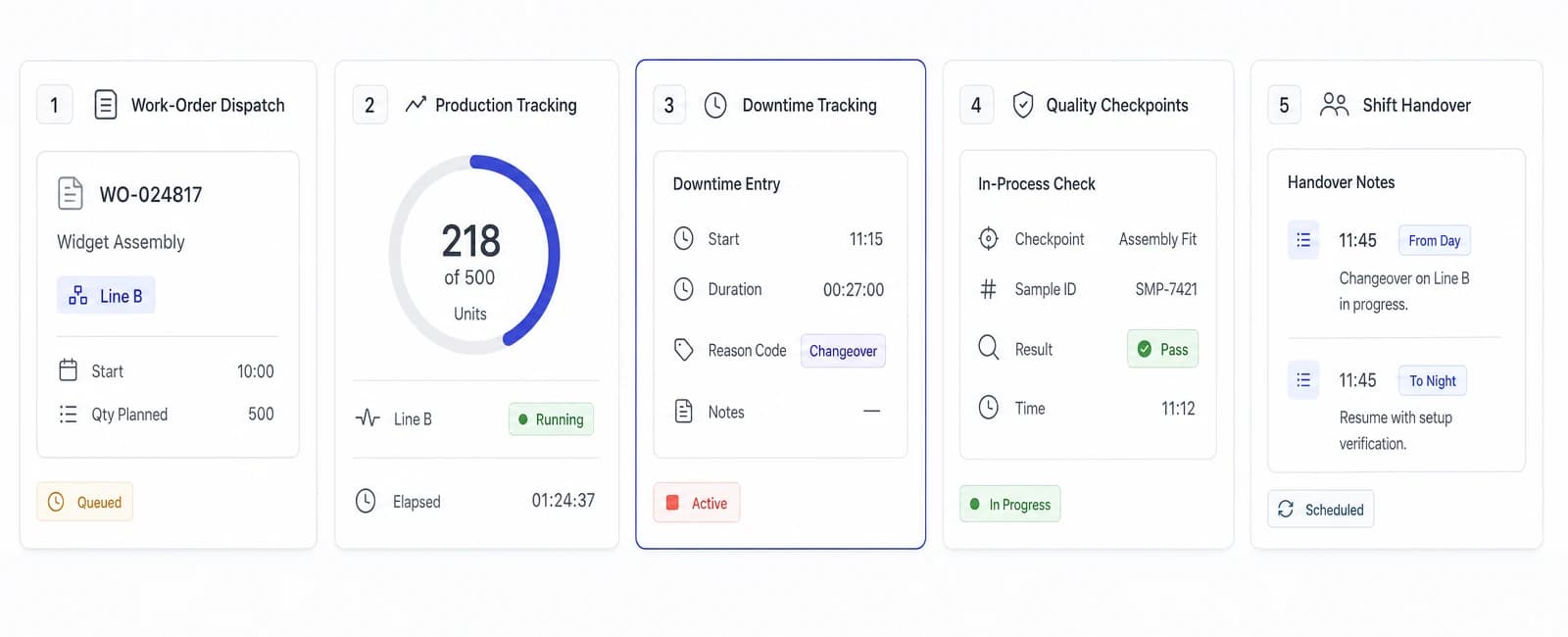
A Manufacturing Execution System (MES) is a representative reference architecture for the shop-floor layer that tracks work orders, machine and operator activity, and quality checks as production actually happens — distinct from an ERP, which plans and finances production at the business level rather than executing it in real time. It illustrates how North Tech Labs would approach real-time production visibility, not a description of a system already built and delivered for a named client.
The business problem
On many shop floors, what's actually happening right now is hard to see. Output, downtime, and quality issues are often logged on paper or in a spreadsheet at the end of a shift, which means the numbers a supervisor sees are already hours old by the time they're available — even when the machines themselves are already generating the underlying data.
Work orders frequently move through the plant on paper travelers or in a planning tool that has no real-time link to the floor, so there's no single, current answer to "what's running on this line right now, and is it on schedule." Reconciling planned versus actual production becomes a manual, after-the-fact exercise rather than something visible in the moment.
This is a distinct gap from business-level planning. An ERP can schedule what should be produced and track the resulting cost and inventory impact, but it typically isn't built to capture second-by- second machine states, operator scans, or in-process quality checks — that's shop-floor execution, and it needs its own system talking directly to the floor.
A Manufacturing Execution System, as a category, addresses that specific layer — dispatching work orders to the floor, capturing production and machine data as it happens, and surfacing downtime and quality issues in real time, so decisions can be made on current conditions rather than yesterday's paperwork.
Intended users & roles
- Shop-floor operatorViews assigned work orders and digital work instructions, logs production counts and scrap, and records issues directly from a line-side device.
- Production supervisorMonitors real-time line and work-order status across a shift, reassigns work, and responds to downtime or quality flags as they occur.
- Quality inspectorPerforms in-process quality checkpoints against defined criteria and records non-conformances tied to the specific unit, batch, or work order.
- Maintenance technicianReceives downtime and equipment-condition alerts routed from the floor and logs the intervention against the affected asset.
- Plant managerReviews cross-line production, downtime, and quality summaries to understand shift and plant performance without pulling data from separate systems manually.
Core modules
- Work-order dispatchReceives planned work orders from the ERP or planning system and releases them to specific lines, cells, or operators in sequence.
- Real-time production trackingCaptures unit and batch counts, cycle times, and progress against the active work order as production happens, not after the fact.
- Machine and equipment data captureIngests machine state, cycle, and condition signals from line equipment through a device/gateway layer to reflect actual run status.
- Downtime trackingRecords stoppages with a reason code as they occur, distinguishing planned, unplanned, and changeover downtime for later analysis.
- Quality checkpointsPresents defined in-process quality checks at the relevant production step and records pass/fail results against the specific unit or batch.
- Digital work instructionsReplaces paper travelers and printed instructions with structured, versioned instructions tied to the active work order and revision.
- Shift handoverConsolidates open work orders, active issues, and pending quality holds into a structured handover between outgoing and incoming shifts.
- Traceability captureRecords the operator, machine, material lot, and timestamp behind each unit or batch as it's produced, structured for later traceability queries.
Example workflows
- Work order released to the floorA work order confirmed in the planning system would appear in the relevant line's queue, with the operator starting it from a line-side device and the system recording actual start time against the plan.
- Unplanned stoppageA line would flag a stoppage from machine data or an operator entry, prompting a reason code before production resumes, with the event routed to a supervisor if it exceeds a defined duration.
- In-process quality holdA quality checkpoint failing its defined criteria would place the affected unit or batch on hold and notify a quality inspector, rather than allowing it to continue downstream unflagged.
- Shift handover summaryAt shift change, open work orders, unresolved downtime events, and pending quality holds would be consolidated into a handover view for the incoming supervisor, rather than relying on a verbal or paper handoff.
- Production data reconciled with the planCompleted work-order quantities and consumed time would be reported back to the planning system, so planned-versus-actual comparisons reflect what the floor actually produced rather than an estimate.
Architecture overview
The system would be built around a real-time, event-driven core — machine states, operator entries, and quality results are captured as discrete events as they occur, rather than aggregated into periodic batch updates, so a supervisor's dashboard reflects current floor conditions rather than a snapshot from the last shift.
Machine and equipment data would enter through a device/gateway integration layer that translates line-level signals (PLC data, sensor readings, machine controller states) into a common event format for the application layer to consume — North Tech Labs builds that software layer, not the sensors, PLCs, or machinery generating the underlying signals.
The system is designed to run on standard cloud infrastructure (AWS is the example used throughout this reference architecture) with a Node.js API layer and PostgreSQL for structured, timestamped production and quality records, with an edge or on-premises component handling the lowest-latency machine-data capture where a plant network requires it.
It's designed to coexist with an existing planning-level system rather than absorb its scope: the MES receives confirmed work orders and reports actuals back, while planning, procurement, and financial decisions remain the responsibility of the business-planning system it integrates with.
- Work-order dispatch
- Real-time production tracking
- Machine and equipment data capture
- Downtime tracking
- Quality checkpoints
- Digital work instructions
- Shift handover
- Traceability capture
- Planning-system integration
- Machine and PLC data ingestion
- Quality-system integration
- Validation before write
- Event-driven status updates
- Role-based access on shared devices
- Session handling for line-side terminals
- Full activity and event log
- Data integrity for traceability
- Encrypted storage and transit
Data & integration flow
- Planning-system integrationConfirmed work orders and schedules are received from the existing business-planning system, and completed quantities and time are reported back, through a defined API integration rather than manual re-entry.
- Machine and PLC data ingestionMachine state, cycle, and condition signals enter through a device/gateway layer that normalizes plant-floor protocols into a common event format for the application to consume.
- Quality-system integrationIn-process checkpoint results and non-conformances are written to, or read from, an existing quality-management system where one is already in place, rather than duplicating quality records.
- Validation before writeProduction counts, quality results, and downtime events are validated against expected ranges and active work-order context before being committed to storage.
- Event-driven status updatesLine, work-order, and equipment status changes are published as events, driving dashboards and alerts without a polling delay.
Security, governance & permissions
- Role-based access on shared devicesAccess to work orders, quality entry, and administrative functions is scoped by role, accounting for shop-floor devices that are typically shared across operators rather than assigned to one person.
- Session handling for line-side terminalsAuthentication is designed for quick operator switching at a shared terminal (badge scan or PIN, for example) rather than assuming a persistent single-user desktop session.
- Full activity and event logWork-order state changes, quality results, downtime events, and manual overrides are logged with who or what recorded them and when, supporting later review.
- Data integrity for traceabilityProduction, material-lot, and quality records are captured in a structured, timestamped form sufficient to support traceability queries, without claiming compliance with a specific regulatory framework unless verified.
- Encrypted storage and transitData at rest and in transit is encrypted, consistent with standard practice for systems handling operational production data.
Relevant services
The engineering disciplines behind Manufacturing Execution System (MES).
- Custom Software DevelopmentDesign and development of secure, scalable custom software for companies across Sweden and the Nordic region.
- IoT & Connected Systems SoftwareSoftware for ingesting, processing, and acting on data from connected equipment and field devices, integrated with your existing operational systems.
- Data Engineering & AnalyticsData pipelines, warehousing, quality validation and BI reporting built to make scattered operational and sensor data reliable enough to trust.
Relevant industries
Where a system like Manufacturing Execution System (MES) creates the most value.
Relevant technologies
The stack Manufacturing Execution System (MES) is built on.
Related solutions
- ERP (Enterprise Resource Planning)A reference architecture for a custom ERP platform that centralises production planning, inventory, procurement, and financials — built to integrate with a manufacturer's existing MES, WMS, and accounting systems rather than replace them outright.
- Warehouse Management System (WMS)A reference architecture for a warehouse management system that combines mobile scanning, real-time inventory tracking, and pick/pack/ship coordination — integrated with existing ERP and transport management systems rather than replacing them.
- Energy Asset Management PlatformA reference architecture for a software platform that consolidates energy asset data — from meters, EV chargers, and sensors already installed across multiple vendors and sites — into one monitoring, alerting, and reporting view for operations and sustainability teams.
Delivery & implementation considerations
- Phased rollout by line or shiftTypically piloted on a single line or shift before wider rollout, so the system is validated against real production conditions before it governs the full plant.
- No production stoppage requiredDeployment is sequenced to avoid requiring a line to stop, with new and legacy tracking methods able to run in parallel during transition.
- Coexistence with the existing ERPDesigned to integrate with a plant's existing planning-level system through defined interfaces rather than requiring its replacement or duplicating its scope.
- Operator-level usabilityInterfaces are designed for shop-floor conditions — shared devices, gloves, noise, time pressure — rather than assumed to be a standard office workstation.
- Data quality before automationMachine-data ingestion and validation are proven reliable before dashboards or downstream reporting are treated as authoritative.
Frequently asked questions
Is this a system you've already built for a client?
No. This page describes a representative reference architecture illustrating our approach to this category of problem — it is not a case study of a completed client project.
How is this different from an ERP?
An ERP plans and manages production at the business level — scheduling, procurement, finance, and inventory. An MES operates one layer down, on the shop floor itself: dispatching work orders, tracking real-time machine and production activity, and capturing quality checkpoints as they happen. The two are designed to integrate, with the MES reporting actuals back to the ERP, not to duplicate each other's scope.
Do you build the machines, sensors, or PLCs this system reads from?
No. North Tech Labs builds the software layer — the device/gateway integration that ingests existing machine and sensor data, and the application built on top of it. We don't manufacture sensors, controllers, or industrial equipment.
Can this run without stopping the production line?
In most cases, yes — deployment is typically phased and piloted on a single line or shift specifically to avoid requiring a full production stop, though the right approach depends on the specific plant and equipment involved.
Does this replace our existing quality-management system?
Not necessarily. The reference architecture is designed to integrate with an existing quality-management system where one is already in place, capturing in-process checkpoints on the floor and exchanging results with that system rather than duplicating it outright.
Does this include predictive analytics or AI-driven decisions?
Not in this reference architecture. It focuses on real-time execution — capturing and surfacing what's happening on the floor now. Predictive or AI-assisted capabilities would be a separate, explicitly scoped addition, not an assumed part of this system.
Ready to discuss your project?
This page describes a representative architecture, not a fixed package. Tell us about your actual requirements and we'll assess what genuinely applies.