This page describes a representative solution and reference architecture. It is not presented as a client case study or as evidence of a completed implementation.
Healthcare Workflow Platform
A reference architecture for an administrative healthcare workflow platform that combines appointment scheduling, a patient self-service portal, and referral coordination with an integration layer connecting to existing EHR/EMR systems — scoped entirely to administrative and operational functionality.
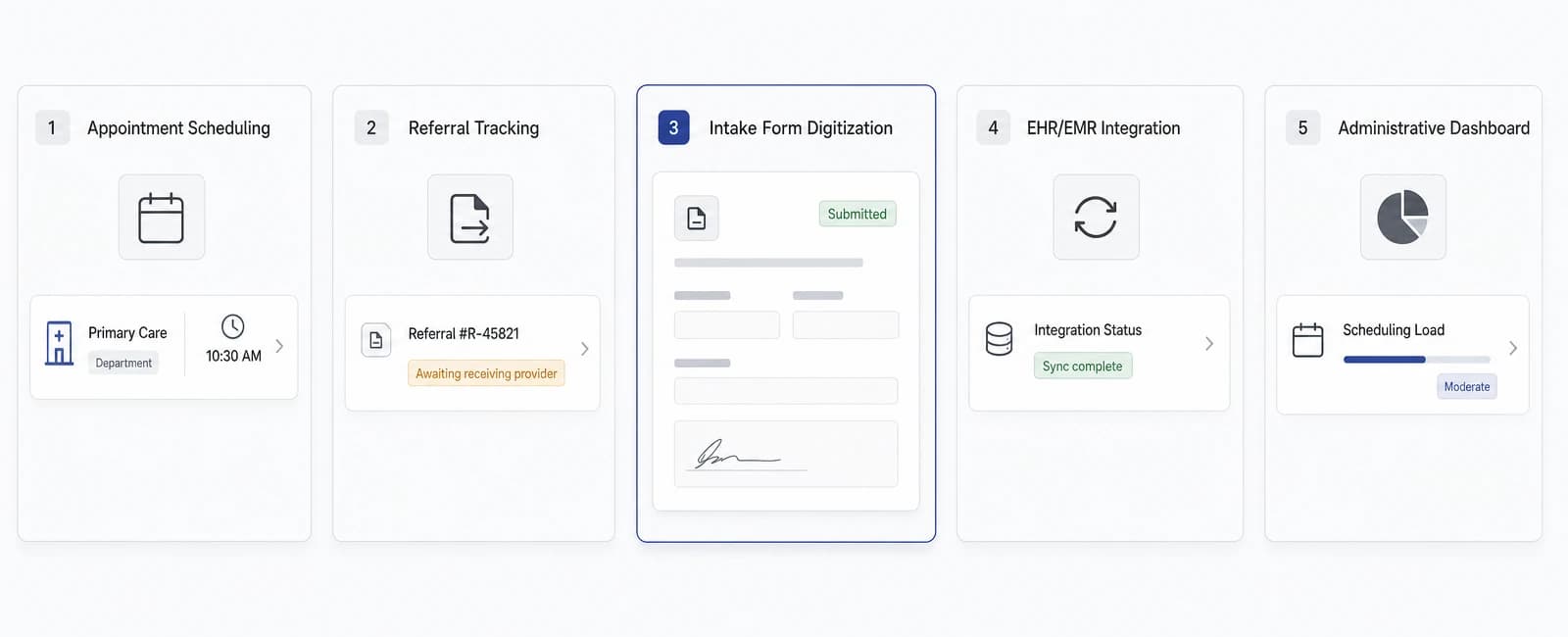
A Healthcare Workflow Platform is a representative reference architecture for administrative and operational healthcare software — appointment scheduling, a patient self-service portal, referral coordination, and intake form digitization — connected to existing EHR/EMR systems through HL7/FHIR interoperability standards. It illustrates how North Tech Labs would approach this category of problem, scoped strictly to administrative and operational workflows, never clinical or diagnostic functionality, and it is not a description of a system already built for a named client.
The business problem
Healthcare providers typically run scheduling on a mix of department-specific tools, spreadsheets, and phone-based coordination, with no single view of availability across sites. Referral status between primary and specialist care is often tracked manually, which makes it difficult for either side of a referral to know where a case currently stands without a phone call or email.
Patient-facing tools frequently lag behind the administrative systems already in place internally — booking an appointment, rescheduling, or checking a referral status may still require calling during office hours, even where the underlying scheduling and records systems are already digital. The gap is usually the patient-facing layer, not a lack of underlying data.
Intake information is commonly collected on paper or in disconnected forms that have to be manually re-entered into scheduling or records systems, and EHR/EMR data often doesn't reach the administrative tools that need it, forcing staff to look records up separately rather than working from a connected view.
A Healthcare Workflow Platform, as a category, is a way to close that specific administrative gap — consolidating scheduling, giving patients self-service access, tracking referrals explicitly, and digitizing intake — while integrating with, rather than replacing, the EHR/EMR systems already in place. It does not extend into clinical or diagnostic functionality.
Intended users & roles
- Scheduling coordinatorManages appointment availability and bookings across departments or sites, and handles rescheduling and waitlist changes.
- Referral coordinatorTracks referrals between referring and receiving providers and follows up on cases that stall or need additional information.
- Patient (self-service)Books, reschedules, or cancels appointments and checks referral or intake status online rather than by phone.
- Clinic administratorOversees scheduling load, referral volume, and staffing needs across a clinic or practice.
- Front-desk staffConfirms appointments, processes walk-ins, and reviews digitized intake submissions ahead of a visit.
Core modules
- Appointment scheduling engineConsolidates appointment availability and bookings across departments or sites into a single administrative view, rather than one per department.
- Patient self-service portalWould let patients book, reschedule, or cancel appointments and check referral or intake status without a phone call.
- Referral tracking workflowGives referring and receiving providers shared visibility into where a referral currently stands, replacing status checks by phone or fax.
- Intake form digitizationConverts paper or ad hoc intake forms into structured digital submissions that route directly into scheduling and administrative records.
- EHR/EMR integration layerConnects scheduling, referral, and intake data with existing EHR/EMR platforms using HL7/FHIR interoperability standards, without duplicating clinical records.
- Appointment reminders & notificationsAutomates appointment reminders and rescheduling notifications to reduce missed appointments.
- Administrative operations dashboardSurfaces scheduling load, referral volume, and intake backlog for clinic administrators to monitor.
- Role-based access controlScopes what each role — front-desk staff, referral coordinator, administrator — can view or act on within the platform.
Example workflows
- Online appointment bookingA patient would check available slots across relevant departments through the self-service portal, select a time, and receive a confirmation and reminder, without needing to call during office hours.
- Referral status handoffA referring provider would submit a referral, the receiving provider's queue would show it as pending, and both sides would see status updates as the case moves forward, rather than relying on a phone call to check.
- Digitized intake ahead of a visitA patient would complete an intake form online before an appointment, structured fields would be extracted and validated, and the record would be routed to front-desk staff for review ahead of the visit rather than re-keyed on paper at check-in.
- EHR/EMR-aware schedulingWhen booking or updating an appointment, the platform would read the minimum administrative data needed from the existing EHR/EMR system through a FHIR-based interface, rather than requiring staff to look records up separately.
- Missed-appointment follow-upA missed or late-cancelled appointment would trigger a rescheduling notification to the patient and update the administrator's dashboard, surfacing a pattern rather than leaving it unrecorded.
Architecture overview
The platform would be built as a web-based backend service with separate interfaces for administrative staff and patients — a Node.js API layer, persistent storage (PostgreSQL is the example used throughout this reference architecture) for scheduling, referral, and intake records, and a defined integration layer for existing EHR/EMR systems.
EHR/EMR integration would be built on HL7 and FHIR, the established interoperability standards for healthcare data exchange, rather than a proprietary format — consistent with how North Tech Labs approaches EHR/EMR integration generally. The integration layer is scoped to administrative data (scheduling, referral status, contact and intake details), not full clinical records.
The system is designed to run on standard cloud infrastructure (AWS is the example used throughout this reference architecture), with a clear boundary between the administrative systems this platform owns and the EHR/EMR systems it integrates with, so those systems' own uptime, rate limits, and data formats can be handled deliberately rather than assumed away.
Where intake forms involve unstructured input, an AI-assisted extraction step would convert submitted text into structured fields for staff review — under the same human-review discipline applied to any AI-assisted step in North Tech Labs reference architectures, and strictly limited to administrative fields rather than clinical interpretation.
- Appointment scheduling engine
- Patient self-service portal
- Referral tracking workflow
- Intake form digitization
- EHR/EMR integration layer
- Appointment reminders & notifications
- Administrative operations dashboard
- Role-based access control
- EHR/EMR integration via HL7/FHIR
- Referral data exchange
- Intake form ingestion
- Validation before write
- Consolidated scheduling data
- Not a certified medical device or clinical system
- GDPR-aware handling of patient data
- Role-based access to administrative data
- Data boundaries with EHR/EMR systems
- Full audit trail
Data & integration flow
- EHR/EMR integration via HL7/FHIRAdministrative data relevant to scheduling and referrals is read from and written to existing EHR/EMR systems through HL7/FHIR interfaces, not by replacing those systems.
- Referral data exchangeReferral records move between referring and receiving providers through a defined workflow and data format, rather than an open-ended set of channels.
- Intake form ingestionDigitized intake submissions enter through a defined intake point and are validated against expected schemas before reaching scheduling or administrative records.
- Validation before writeExtracted or submitted data is validated against expected schemas and business rules before it's written to the platform's own records or synced to an EHR/EMR system.
- Consolidated scheduling dataScheduling data previously scattered across departmental tools is reconciled into a single data model rather than kept in separate silos.
Security, governance & permissions
- Not a certified medical device or clinical systemNorth Tech Labs is not a certified medical device manufacturer. This reference architecture describes administrative and operational functionality only — scheduling, a patient portal, referral tracking, and intake digitization — and is not clinically validated diagnostic or decision-support software. Organizations requiring certified medical device software should work with a manufacturer qualified for that regulatory pathway.
- GDPR-aware handling of patient dataThe platform is designed around GDPR data-protection principles — access scoping, data minimization, and deliberate handling of personal data — as a design practice, not a claim of certified compliance with GDPR, HIPAA, or any other specific regulatory framework.
- Role-based access to administrative dataAccess to scheduling, referral, and intake data is scoped by role — front-desk staff, referral coordinator, administrator — rather than granting broad default visibility.
- Data boundaries with EHR/EMR systemsThe integration layer passes only the administrative data required for scheduling or referral purposes, rather than duplicating full clinical records into systems that don't need them.
- Full audit trailScheduling changes, referral status updates, and intake submissions are logged with who or what acted and when, supporting later administrative review.
AI controls
- Human review for intake extractionStructured fields extracted from digitized intake forms are reviewed by front-desk or administrative staff before being treated as confirmed, rather than auto-accepted.
- Scoped to administrative fields onlyAI-assisted extraction is limited to administrative and contact fields on intake forms — never clinical interpretation, triage, or diagnostic judgment.
- Confidence thresholds & validationIntake extractions below a defined confidence threshold are routed to manual review rather than assumed correct.
- Defined fallback behaviourWhen intake extraction fails or produces invalid output, the submission is routed to manual review rather than silently dropped or guessed at.
Relevant services
The engineering disciplines behind Healthcare Workflow Platform.
- Custom Software DevelopmentDesign and development of secure, scalable custom software for companies across Sweden and the Nordic region.
- API Development & Systems IntegrationAPI design, partner integrations, and systems-integration engineering connecting ERP, MES, WMS, and third-party platforms into a reliable data flow.
- Data Engineering & AnalyticsData pipelines, warehousing, quality validation and BI reporting built to make scattered operational and sensor data reliable enough to trust.
Relevant industries
Where a system like Healthcare Workflow Platform creates the most value.
Related solutions
- Document Processing PlatformA reference architecture for a document processing system that extracts structured obligations, key dates, clauses, and risk flags from contracts and compliance documents at scale — built around a review and redlining workflow where a person confirms every extraction before it's treated as fact.
- AI Knowledge AssistantA reference architecture for an internal knowledge assistant that answers employee questions in natural language, grounded in an organisation's own documents and wikis — every answer traceable to the source it came from, and scoped to what the asking user is already permitted to see.
Delivery & implementation considerations
- Scope kept to administrative and operational systemsEngagements are scoped explicitly around scheduling, the patient portal, referral workflows, and intake digitization — not clinical, diagnostic, or decision-support functionality.
- Phased rollout by workflowTypically implemented one workflow at a time — starting with scheduling consolidation before layering in the patient portal, referral tracking, or intake digitization.
- Coexistence with existing EHR/EMR systemsDesigned to integrate with the EHR/EMR platforms already in place using HL7/FHIR standards, rather than assuming their replacement.
- Staff and patient adoptionThe portal and intake tools are designed for realistic daily use by clinic staff and patients, since adoption depends on the tool being genuinely faster than the phone call or paper form it replaces.
- Integration resilienceInterfaces to existing EHR/EMR systems are designed to tolerate those systems' own downtime, rate limits, and inconsistent data formats.
Frequently asked questions
Is this a system you've already built for a client?
No. This page describes a representative reference architecture illustrating our approach to this category of problem — it is not a case study of a completed client project.
Is this a certified medical device or clinical software?
No. This platform is scoped to administrative and operational functionality — scheduling, a patient portal, referral tracking, and intake digitization. North Tech Labs is not a certified medical device manufacturer, and this architecture is not clinically validated diagnostic or decision-support software.
Does this replace our existing EHR or EMR system?
No. The architecture integrates with existing EHR/EMR systems using HL7/FHIR interoperability standards rather than replacing them, and it passes only the administrative data needed for scheduling or referral purposes.
Does the platform make clinical decisions or triage patients?
No. Any AI-assisted step in this architecture — such as intake form extraction — is limited to administrative fields and requires human review. Clinical judgment, triage, and diagnosis are outside the scope of this platform.
Is this GDPR-compliant or HIPAA-compliant?
The architecture is designed around GDPR data-protection principles — access scoping, data minimization, and deliberate handling of personal data — as a design practice, not a certification claim. Organizations with specific regulatory obligations should confirm compliance requirements with their own legal and compliance advisors.
Can patients really book and manage appointments themselves?
That's the intent of the patient self-service portal module — letting patients book, reschedule, or check referral status online — though the specific capabilities depend on how a given engagement is scoped.
Ready to discuss your project?
This page describes a representative architecture, not a fixed package. Tell us about your actual requirements and we'll assess what genuinely applies.