Manufacturing
We build operational software for manufacturers — production visibility, quality workflows, maintenance planning, and the integration layers that connect shop-floor systems with the rest of the business.
- Production visibility
- Traceability
- ERP/MES/WMS integration
- Quality workflows
- Maintenance planning
Manufacturing software development covers the operational systems manufacturers use to run production, track quality, plan maintenance, and connect shop-floor activity with back-office systems — from production dashboards and quality workflows to the data-integration layers that tie ERP, MES, WMS, and equipment data together. North Tech Labs builds these as custom systems shaped around how a specific plant or operation actually runs, not generic industrial software.
Sector context
Manufacturers typically run on a mix of systems accumulated over years — an ERP for finance and planning, a separate MES or none at all, spreadsheets for quality records, and equipment that speaks its own proprietary protocol. Software built to connect these systems has to work with what already exists, not replace it wholesale.
Production data is often captured manually, hours or shifts after the fact, which makes real operational visibility difficult even when the underlying equipment is already collecting the numbers. The gap is usually integration and workflow, not a lack of raw data.
Modernisation in this sector tends to succeed when it's phased around a live production environment — a system that requires shutting down a line to deploy carries real operational cost, so architecture and rollout planning matter as much as the software itself.
Operational and digital challenges
- Production data is captured manually or after the factOperators log output, downtime, and quality issues on paper or in spreadsheets, so decisions are made on yesterday's information.
- Core systems don't talk to each otherERP, MES, WMS, and equipment controllers often operate as separate islands, requiring manual reconciliation between them.
- Traceability requirements are hard to meet after the factTracing a batch, lot, or component back through the production process is difficult when the underlying data was never captured in a structured, queryable form.
- Maintenance is reactive rather than plannedEquipment issues are addressed after a failure rather than anticipated from usage and condition data that may already exist but isn't consolidated.
- Legacy systems can't be replaced without disrupting productionA live production line can't simply be paused for a software migration, which constrains how modernisation can realistically be sequenced.
Software capabilities
- Production dashboards and shift reporting
- Digital work instructions
- Role-based operator and supervisor interfaces
- Shop-floor to back-office workflow systems
- Quality-management workflows and non-conformance tracking
- Batch and lot traceability platforms
- Supplier and incoming-materials quality records
- Audit-ready data capture
- ERP, MES, and WMS integration layers
- Equipment and sensor data ingestion (device/gateway integration, not hardware manufacturing)
- Industrial data platforms consolidating multiple sources
- Reporting and decision-support dashboards
Representative systems
The examples below describe common system types and potential engineering applications. They do not represent undisclosed client projects.
- Production overview
- Work orders
- Quality checks
- Maintenance
- Materials
- Traceability
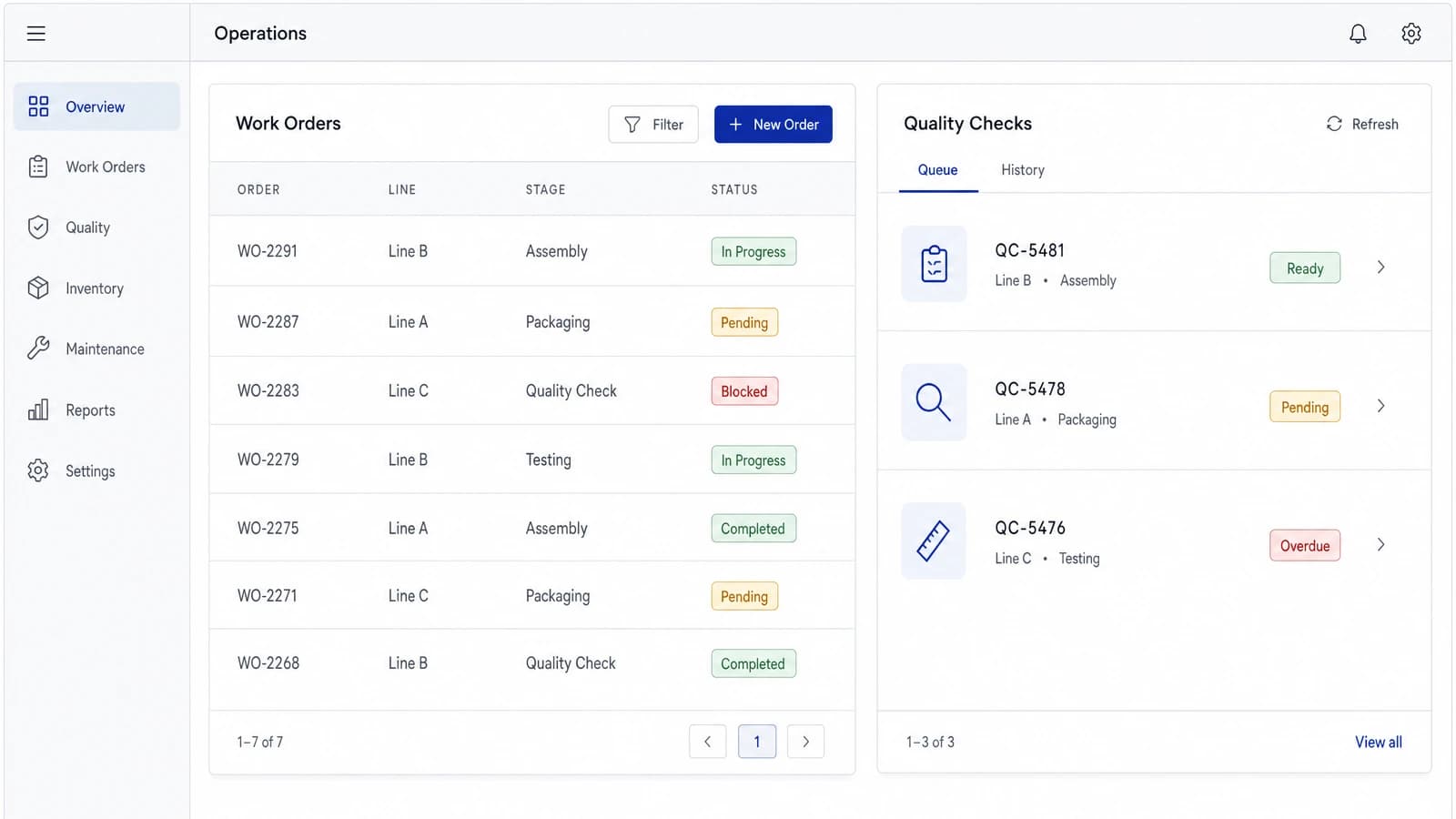
| Work order | Line | Stage | Status |
|---|---|---|---|
| WO-2291 | Line B | Assembly | In progress |
| WO-2288 | Line A | Quality check | Review required |
| WO-2284 | Line C | Packaging | Completed |
| WO-2279 | Line B | Materials staged | Scheduled |
- Batch QC — Line A, shift 2Quality checksNeeds attention
- Traceability export — WO-2284TraceabilityIn progress
- Preventive maintenance — Line BMaintenanceScheduled
- Manufacturing operations platformA system coordinating production scheduling, shift handover, and shop-floor reporting in one place.
- Quality-management workflowA structured system for logging, tracking, and resolving quality issues and non-conformances.
- Predictive-maintenance platformA system consolidating equipment condition data to support planned rather than reactive maintenance.
- Equipment-monitoring dashboardA dashboard surfacing machine and line status from existing sensor or controller data.
- Digital work-instruction systemA system replacing paper work instructions with structured, versioned digital procedures.
- Traceability platformA system recording batch, lot, or component data through production for after-the-fact tracing.
- Supplier portalA self-service platform for suppliers to submit documentation, certifications, or delivery data.
- Industrial data integration layerA system connecting ERP, MES, WMS, and equipment data into a single consolidated source.
Relevant services
- Custom Software DevelopmentDesign and development of secure, scalable custom software for companies across Sweden and the Nordic region.
- AI DevelopmentProduction-oriented AI systems, assistants, RAG platforms and intelligent automation for Nordic businesses.
- Mobile App DevelopmentProduct-focused mobile application development for iOS and Android, from architecture and UX to release and ongoing evolution.
Delivery considerations
- Phased rollout around live productionDeployments are sequenced to avoid requiring a production line to stop, often piloting on one line or shift before a wider rollout.
- Coexistence with existing systemsNew systems are designed to integrate with the ERP/MES/WMS already in place rather than assuming a clean-slate replacement.
- Operator-level usabilityInterfaces are designed for shop-floor use — often shared devices, gloves, or noisy environments — not assumed to be a standard office workstation.
Architecture, data & integration considerations
- Equipment and sensor data ingestionA clear boundary between device/gateway-level data ingestion and the cloud or edge processing that consumes it — North Tech Labs builds the software layer, not the sensors or machinery themselves.
- Data consolidationA data model that reconciles ERP, MES, WMS, and equipment data sources that were never designed to share a common structure.
- Integration resilienceInterfaces to existing industrial systems designed to tolerate those systems' own downtime and inconsistent data quality.
- AuditabilityStructured, timestamped data capture sufficient to support traceability and quality-audit requirements after the fact.
Security, privacy & compliance considerations
- Role-based access on the shop floorAccess control appropriate to shared shop-floor devices, distinct from typical office-based user-account assumptions.
- Data integrity for audit trailsTraceability and quality records are captured and stored in a way that supports later audit review, without claiming compliance with a specific regulatory framework unless verified.
Where this fits
Frequently asked questions
What is manufacturing software development?
It's the design and engineering of operational systems manufacturers use to run production, track quality, plan maintenance, and integrate previously disconnected systems like ERP, MES, and WMS — built around how a specific operation actually works.
Do you build the sensors or industrial hardware?
No. North Tech Labs builds the software layer — data ingestion from existing devices and gateways, integration, and the applications built on top. We don't manufacture sensors, machinery, or industrial control hardware.
Can this integrate with our existing ERP or MES?
Yes — integrating with existing ERP, MES, and WMS systems is a core part of most manufacturing engagements, rather than replacing them outright.
Can a system be deployed without stopping production?
In most cases, yes — deployments are typically phased and piloted on a single line or shift specifically to avoid requiring a full production stop, though the right approach depends on the specific system and environment.
Working in Manufacturing?
Tell us which systems don't talk to each other today — ERP, MES, WMS, or the shop floor — and we'll scope from there.